










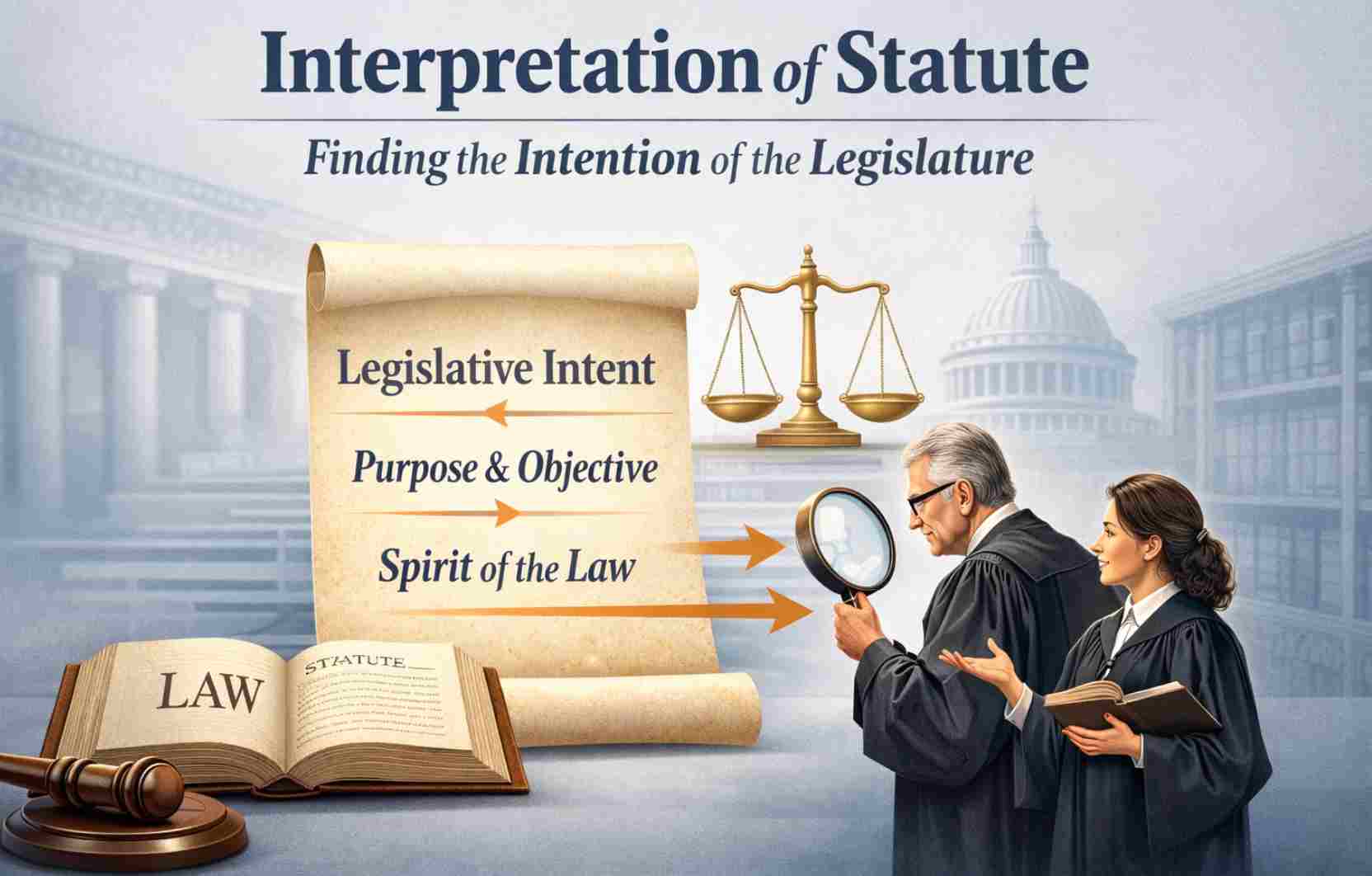
When people first hear the phrase interpretation of statute, they often imagine judges sitting in court, reading heavy law books, and arguing over the meaning of words.
While that picture is not entirely wrong, it misses the real heart of statutory interpretation. Interpretation of statute is not just about dictionary meanings.
It is about understanding what the legislature wanted to achieve when it made a law.
A statute is nothing more than a written expression of legislative will. The legislature cannot speak directly to citizens or courts.
It communicates through words written in Acts. But words have limitations. They are general, sometimes vague, and often incapable of covering every possible situation.
Because of this, courts are required to interpret statutes so that the intention behind them is properly understood and applied.
This is why jurists repeatedly say that the interpretation of a statute means finding out the intention of the legislature. Everything else flows from this idea.
Why Interpretation Is Necessary at All
If laws were always clear and precise, interpretation would hardly be needed. But in reality, no statute is perfect.
Legislators draft laws in advance, imagining future situations, but life rarely follows exact patterns.
New problems arise, society changes, technology develops, and old words are applied to new realities.
Sometimes a statute uses broad terms so that it can apply to many situations. Sometimes it avoids detailed definitions to remain flexible.
At other times, drafting errors creep in. Words may be missing, sentences may be awkward, or provisions may overlap.
When a dispute reaches court, the judge cannot simply say the law is unclear and refuse to decide. The court must interpret the statute and apply it.
In doing so, it must remain faithful to what the legislature intended.
Legislature as the Lawmaker and Court as the Interpreter
In a democratic system, the legislature has the authority to make laws. Courts do not possess this power. Their duty is to interpret and enforce laws.
This division of roles is essential to maintain balance in governance.
If courts begin to change laws under the name of interpretation, they would effectively become lawmakers. That would undermine democracy.
Therefore, courts constantly remind themselves that interpretation is about discovering legislative intention, not replacing it.
The Supreme Court of India has repeatedly emphasized this principle.
In Union of India v. Deoki Nandan Aggarwal, the Court clearly stated that judges cannot add words to a statute or fill gaps on the assumption that the legislature made a mistake.
If a law is defective, it is for the legislature to correct it.
This case reflects the discipline courts must follow while interpreting statutes.
What Exactly Is Legislative Intention
Legislative intention does not mean what individual members of parliament personally thought. Legislatures are collective bodies.
The only reliable evidence of their intention is the statute itself.
Courts look at the words used, the structure of the Act, its purpose, and the problem it was meant to solve.
Legislative intention is found by reading the statute as a whole and understanding it in its proper context.
In Girdhari Lal & Sons v. Balbir Nath Mathur, the Supreme Court observed that the intention of the legislature must be gathered from the language used, keeping in mind the object of the statute. This intention is not imaginary. It is embedded within the law itself.
The Starting Point Is Always the Language of the Statute
When courts begin interpretation, they start with the text. Words matter. They are the first guide to legislative intention.
The ordinary meaning of words is generally accepted unless there is a reason to believe the legislature intended otherwise.
This approach respects the legislature and avoids unnecessary judicial interference.
In Kanai Lal Sur v. Paramnidhi Sadhukhan, the Supreme Court held that when statutory language is clear and unambiguous, courts should not try to interpret it differently merely because another interpretation seems more reasonable.
However, clarity is not always present.
When Literal Meaning Causes Problems
There are situations where applying the plain meaning of words leads to results that are unreasonable, unjust, or even absurd.
Courts do not assume that the legislature intended such outcomes.
For instance, a law may be worded broadly, but its application in a particular case may defeat its very purpose.
In such cases, courts look beyond literal meaning to find legislative intention.
This principle was recognized long ago in Grey v. Pearson, where the court stated that the ordinary meaning of words should be followed unless it leads to absurdity or inconsistency.
Indian courts have consistently followed this reasoning.
Golden Rule and Common Sense
The golden rule allows courts to modify the literal meaning of words slightly in order to avoid absurd results.
It is based on common sense and fairness.
In State of Punjab v. Qaiser Jehan Begum, the Supreme Court used this approach to avoid an unreasonable interpretation that would have contradicted the purpose of the statute.
The golden rule does not give judges freedom to change laws.
It simply allows them to interpret words in a manner that makes sense and aligns with legislative intention.
Problem the Law Was Meant to Solve
Sometimes, the best way to understand a law is to understand why it was passed.
What problem existed before the law? What harm was the legislature trying to prevent?
This approach is known as the mischief rule, originating from Heydon’s Case.
It asks the court to identify the mischief in the old law and interpret the new law in a way that suppresses that mischief.
The Supreme Court applied this approach in Bengal Immunity Co. v. State of Bihar.
The Court examined the historical background and interpreted constitutional provisions in a manner that removed the mischief the framers wanted to eliminate.
This method directly connects interpretation with legislative intention.
Purposive Interpretation in Modern Times
Modern courts often use purposive interpretation, especially in complex statutes dealing with taxation, welfare, environment, and constitutional rights.
Purposive interpretation focuses on the objective of the statute rather than rigid wording. It asks a simple question. What was this law meant to achieve?
In K.P. Varghese v. Income Tax Officer, the Supreme Court rejected a literal interpretation of tax provisions that would have penalized honest taxpayers.
The Court held that interpretation should promote the purpose of the law and prevent misuse.
This judgment is frequently cited because it clearly demonstrates that legislative intention outweighs technical wording.
Context Gives Meaning to Words
Words used in a statute cannot be understood by pulling them out of their surroundings and examining them on their own.
Just like in everyday language, the meaning of a word often becomes clear only when we look at the sentence it appears in and the idea that the sentence is trying to convey.
In law, this becomes even more important because a single word can affect rights, duties, and liabilities.
The Supreme Court explained this idea very clearly in Reserve Bank of India v. Peerless General Finance and Investment Co.
The Court pointed out that interpretation is not only about reading the text, but about reading the text in its proper context.
A word does not carry the same meaning in every situation. Its meaning can change depending on the surrounding words, the subject of the statute, and the purpose the law seeks to achieve.
That is why courts do not read statutory provisions in isolation. They read the entire statute together, examining how different sections relate to each other.
By doing this, courts avoid narrow or misleading interpretations and are better able to give effect to the true intention of the legislature.
Scheme and Structure of the Act
At times, looking only at a single section of a statute does not reveal what the legislature actually intended.
A provision may appear unclear or even misleading when read on its own.
However, when that same provision is read as part of the entire Act, its meaning often becomes much clearer.
This is because every law is drafted with a particular structure and plan in mind. Each section is meant to play a specific role within that larger framework.
This idea was clearly recognized by the Supreme Court in Doypack Systems Pvt. Ltd. v. Union of India.
The Court observed that to understand the true meaning of a statutory provision, one must look at the object of the Act and the scheme under which the provision operates.
Isolating words or sections can distort their meaning and lead to conclusions that the legislature never intended.
This approach avoids narrow and technical readings and helps the law function as a coherent whole, in line with its broader purpose.
Role of Legislative History
Legislative history includes background materials, reports, and circumstances surrounding the enactment of a law.
Courts sometimes use these materials to clarify ambiguities.
In R.S. Nayak v. A.R. Antulay, the Supreme Court referred to legislative background to interpret provisions relating to special courts.
However, the Court also warned that legislative history cannot override clear statutory language.
Thus, legislative history acts as an aid, not a replacement for statutory text.
Interpretation of Penal Laws
Penal statutes affect personal liberty. Because of this, courts interpret them strictly.
If a criminal law is vague or ambiguous, courts do not assume the legislature intended to punish conduct that is not clearly covered.
In Tolaram Relumal v. State of Bombay, the Supreme Court held that when two reasonable interpretations of a penal provision are possible, the one favorable to the accused should be adopted.
This principle itself reflects legislative intention to punish only clear and defined offenses.
Interpretation of Welfare and Beneficial Laws
Welfare laws are enacted to protect weaker sections of society. Courts interpret them liberally to ensure benefits reach intended beneficiaries.
In Workmen of American Express International Banking Corporation v. Management, the Supreme Court held that beneficial legislation must be interpreted in a manner that advances its purpose.
This does not mean ignoring statutory language. It means interpreting it in a way that fulfills legislative intention.
Interpretation and Changing Society
Laws often outlive the conditions in which they were enacted. Courts must apply old laws to new situations.
For example, technology has created challenges that lawmakers decades ago could not have imagined.
Courts interpret existing laws to address these challenges while respecting original legislative intention.
This approach keeps the law alive without altering its foundation.
Courts Cannot Rewrite Laws
Judges often face statutes that appear incomplete or outdated. However, courts cannot rewrite laws under the name of interpretation.
In State of Gujarat v. Dilipbhai Nathjibhai Patel, the Supreme Court held that courts cannot supply omissions or correct defects in legislation. Their role is limited to interpretation.
This boundary is crucial to maintain democratic balance.
Interpretation and Legal Certainty
Consistent interpretation builds trust in the legal system. When courts focus on legislative intention, similar cases are treated similarly.
This predictability allows citizens to plan their actions according to law.
Interpretation in Daily Life
Most people encounter statutory interpretation indirectly.
Tax assessments, labor disputes, property rights, environmental regulations, and criminal cases all depend on how statutes are interpreted.
A small change in interpretation can affect thousands of people. That is why courts approach interpretation with caution and responsibility.
The Core Idea
If you imagine a statute as a message sent by the legislature, interpretation is the process of understanding that message correctly.
Misunderstanding it can distort justice.
The intention of the legislature is the guiding light in this process. Words are important, but intention gives them meaning.
Courts do not search for hidden motives. They seek clarity, purpose, and consistency.
Verdict
Interpretation of statute is about understanding what the law is meant to achieve, not about rigidly reading words in isolation.
Courts do not approach statutes as technical documents to be decoded mechanically. Instead, they treat them as expressions of legislative will.
The purpose behind the law, the problem it seeks to address, and the way its provisions fit together all guide the process of interpretation.
Judges rely on established principles of interpretation because these principles help ensure that the authority of the legislature is respected.
Each rule exists to prevent misapplication of the law and to ensure that statutes operate in a practical and meaningful manner.
When courts give priority to legislative intention over narrow word meanings, the law remains effective in real life situations.
This approach explains why legal theory consistently states that interpretation of statute means discovering and giving effect to the intention of the legislature.
Follow The Legal QnA For More Updates…
