



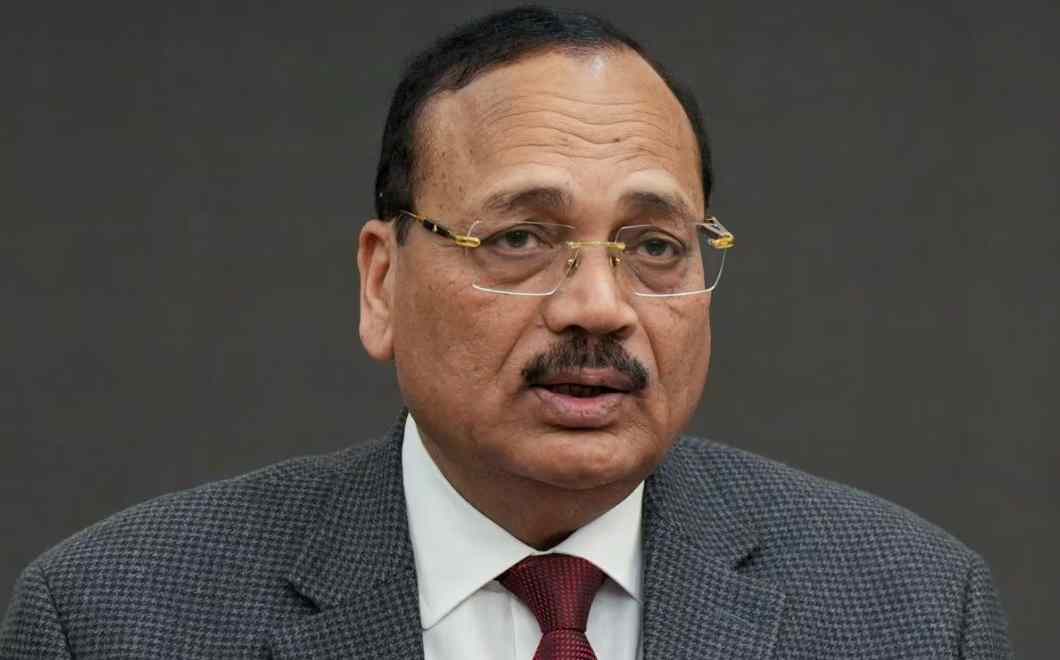
Hon’ble Mr. Justice Surya Kant
53rd Chief Justice of India
| Full Name | Surya Kant Sharma |
| Current Office | 53rd Chief Justice of India (CJI) |
| Tenure as CJI | November 24, 2025 – February 9, 2027 |
| Preceded By | Hon’ble Mr. Justice B.R. Gavai (52nd CJI) |
| Successor (Next CJI) | Hon’ble Mr. Justice Vikram Nath (expected) |
| Home State | Haryana (Village Petwar, Hisar) |
Justice Surya Kant is the 53rd Chief Justice of India, known for his agrarian roots and strict judicial stance on digital crimes. He assumed office on November 24, 2025, becoming a pivotal figure in modernizing the Indian judiciary. He is notably the first Chief Justice of India hailing from the rural heartlands of Haryana.
I. Career, Tenure & Appointments
Who is the 53rd Chief Justice of India?
The 53rd Chief Justice of India is Justice Surya Kant, a first-generation lawyer who rose from the Punjab & Haryana Bar to the apex court.
When did Justice Surya Kant take the oath as CJI?
He was sworn in as the 53rd Chief Justice of India on November 24, 2025.
When will Justice Surya Kant retire?
Justice Surya Kant will retire from the office of Chief Justice of India on February 9, 2027, upon attaining the age of 65 years.
How long is the tenure of Justice Surya Kant as CJI?
Justice Surya Kant will serve a tenure of approximately 1 year and 2.5 months (about 14–15 months) as Chief Justice of India, from November 24, 2025 to February 9, 2027.
Who did Justice Surya Kant succeed as the Chief Justice of India?
He succeeded Justice B.R. Gavai, the 52nd Chief Justice of India, who demitted office on November 23, 2025.
Who will be the next CJI after Justice Surya Kant?
Based on the established seniority convention, he is expected to be succeeded by Justice Vikram Nath in February 2027.
Is Justice Surya Kant the first Chief Justice of India from Haryana?
Yes. Justice Surya Kant is the first-ever Chief Justice of India from the state of Haryana, and the first CJI from the rural belt of Hisar.
- Advocate General of Haryana (2000): He earned the distinction of being the youngest Advocate General in Haryana’s history at the age of 38, appointed on 7 July 2000 and designated a Senior Advocate in 2001.
- High Court Judge (2004): Elevated to the Bench of the Punjab and Haryana High Court on January 9, 2004.
- Chief Justice of HP High Court (2018): Served as Chief Justice of the Himachal Pradesh High Court from October 5, 2018 until his elevation to the Supreme Court.
- Supreme Court Elevation (2019): Elevated to the Supreme Court of India on May 24, 2019, where he served as a Judge until November 23, 2025.
- NALSA Executive Chairman: Before becoming CJI, he served as the Executive Chairman of the National Legal Services Authority (NALSA), focusing on legal aid for the poor and expanding legal clinics across the country.
Was Justice Surya Kant the Advocate General of Haryana?
Yes. He was appointed Advocate General for the State of Haryana in July 2000, becoming the youngest to hold that post.
Which High Court was Justice Surya Kant the Chief Justice of before the Supreme Court?
Before his elevation to the Supreme Court, he served as the Chief Justice of the Himachal Pradesh High Court.
When was Justice Surya Kant elevated to the Supreme Court of India?
He was elevated as a Judge of the Supreme Court of India on May 24, 2019.
In which High Court did Justice Surya Kant start his practice?
After a brief stint at the District Courts in Hisar, he shifted to Chandigarh in 1985 and started his core practice in the Punjab & Haryana High Court, specialising in Constitutional, Service and Civil matters.
II. Biography & Personal Background
Where was he born?
He was born in Village Petwar, District Hisar, Haryana, on February 10, 1962.
Which state is Justice Surya Kant from?
Justice Surya Kant is from the northern Indian state of Haryana, with deep roots in its rural, agrarian society.
Family & Caste Background:
Justice Surya Kant comes from a middle-class agricultural family. His father, Shri Madan Gopal Sharma, was a Sanskrit teacher often remembered in his village as “Masterji”. He belongs to the Brahmin community but is widely respected for his agrarian identity and simplicity.
Who is the wife of Justice Surya Kant?
His wife, Savita Kant, is a retired government college principal and academic who has taught English and served in higher education in Haryana and Chandigarh.
Who are the family members of Justice Surya Kant? Does he have a son?
Justice Surya Kant hails from a close-knit family with three elder brothers and a sister. Public reports describe him as married with daughters; there is no widely reported public information about him having a son.
Is he from a family of lawyers?
No. Unlike many judges who hail from legal dynasties, Justice Surya Kant is a first-generation lawyer who rose through merit and hard work.
What is the religion of Justice Surya Kant?
Public biographical profiles describe Justice Surya Kant as coming from a Hindu family background. In his public life, however, he is known for a strongly secular and constitutional outlook, focusing on equality before law rather than personal identity.
Education – What is the educational qualification of Justice Surya Kant?
He is highly qualified in law and liberal arts. His formal degrees include:
- B.A. (Geography) from Government Post Graduate College, Hisar (1981)
- LL.B. from Maharishi Dayanand University (MDU), Rohtak (1984)
- LL.M. (First Class First) from Kurukshetra University (2011), completed while serving on the Bench.
Which college did Justice Surya Kant attend?
He completed his graduation from Government Post Graduate College, Hisar, followed by his law degree from MDU, Rohtak.
What is the full name of Justice Surya Kant?
His full name is Surya Kant Sharma, though he is publicly and judicially known as Justice Surya Kant.
III. Notable Judgments & Views
Justice Surya Kant has delivered critical verdicts impacting national security, social welfare, electoral transparency, and digital rights. He is known for balancing individual freedoms with accountability in the digital age.
What was Justice Surya Kant’s verdict on the abrogation of Article 370?
He was a member of the 5-judge Constitution Bench that unanimously upheld the abrogation of Article 370, thereby affirming Parliament’s decision to reorganize the erstwhile State of Jammu & Kashmir and integrate it more closely with the Union of India.
Did Justice Surya Kant uphold the One Rank One Pension (OROP) scheme?
Yes. In March 2022, a bench led by him upheld the Centre’s OROP scheme for the armed forces, holding that there was no constitutional infirmity in the policy while also directing periodic revision and implementation safeguards.
What is Justice Surya Kant’s stance on the Sedition Law in India?
Justice Surya Kant was part of the bench that effectively put Section 124A (sedition) of the IPC/BNS in abeyance, directing that no new FIRs be registered and that ongoing prosecutions be paused while the Union Government reviews the colonial-era law. His approach signals a strong concern for free speech and the chilling effect of overbroad criminal provisions.
What did Justice Surya Kant say about the “India’s Got Latent” show controversy?
In the controversy surrounding the show “India’s Got Latent”, hosted by comedian Samay Raina and featuring other creators, Justice Surya Kant strongly rebuked the content for mocking persons with disabilities. He has stressed that “digital fame cannot come at the cost of human dignity” and has directed the performers to host awareness and fundraising shows supporting persons with disabilities as a form of restorative, community-oriented remedy.
What are Justice Surya Kant’s views on “digital arrest” scams?
Justice Surya Kant has described “digital arrest” cyber frauds as an “assault on the dignity of the justice system” and a “nightmare for citizens”.
In a suo motu matter, benches led by him have:
- Restrained lower courts from releasing accused on bail in grave digital-arrest fraud cases without the Supreme Court’s permission.
- Called for the problem to be tackled with an “iron hand”, including better digital forensics and bank-response protocols.
- Directed systemic safeguards so that forged “court orders” and impersonation of judges or police online are dealt with as organised crime.
Abrogation of Article 370: Part of the Constitution Bench that upheld the abrogation of Article 370, validating the integration and reorganisation of Jammu & Kashmir.
One Rank One Pension (OROP): Led the bench that upheld the Centre’s OROP scheme for the armed forces while underscoring the State’s obligation towards ex-servicemen.
Sedition Law (Section 124A): Was part of the bench that kept the sedition law in abeyance, signalling a re-thinking of colonial-era restrictions on free speech.
Pegasus & Digital Surveillance: In matters concerning alleged use of the Pegasus spyware, supported the need for independent inquiry and safeguards on state surveillance and privacy.
Electoral Reforms & Article 212: Part of decisions on electoral bonds, electoral roll revisions, and legislative privilege, emphasising transparency and constitutional limits on legislative action.
Jail & Prison Reforms: As a High Court judge, authored the Jasvir Singh judgment, directing Punjab to frame a scheme for conjugal and family visits for prisoners, pioneering a rights-based approach to prison administration.
Recent Key Interventions
1. “India’s Got Latent” Show Controversy:
Addressing the controversy surrounding the show hosted by Samay Raina, Justice Surya Kant strongly rebuked the creators for content deemed insensitive to persons with disabilities. The Court directed the comedians to host awareness shows and disability fundraisers and explore guidelines on harmful online content, linking digital accountability with social responsibility.
2. Stance on “Digital Arrest” Scams:
Terming “Digital Arrests” a “nightmare for citizens” and an attack on institutional credibility, Justice Surya Kant has taken a strict view. He has restrained release of key accused in some high-value frauds, called for treating such cases as organised crime, and pressed banks and investigative agencies to strengthen flagging mechanisms and victim-protection protocols.
IV. Controversies & Specifics
What were the allegations regarding land allotment?
During his elevation to the Supreme Court in 2018–19, a former judge wrote to the Collegium raising objections regarding a property allotment in Chandigarh. The then Chief Justice of India, Justice Dipak Misra, examined the matter and found no merit in the allegations, clearing the way for Justice Surya Kant’s elevation. The issue is generally viewed as having been settled at the institutional level.
What are the allegations against Justice Surya Kant more broadly?
Apart from the Chandigarh land allotment question (which was examined and closed by the Collegium), Justice Surya Kant has not faced sustained allegations of personal corruption. His more recent scrutiny has largely related to the content of his judgments, for example, firm remarks in free-speech and digital-regulation cases, rather than personal misconduct.
What did the Indian Express report about Justice Surya Kant?
The Indian Express has carried multiple reports and profiles on Justice Surya Kant, including:
- Coverage of the land allotment letter during his elevation and how the Collegium resolved it.
- Reports on his appointment as Chief Justice of Himachal Pradesh High Court and later as the 53rd CJI.
- Detailed coverage of his role in cases like digital arrest scams and the “India’s Got Latent” controversy, highlighting his emphasis on dignity, accountability and structured regulation of online content.
What is the net worth/assets of Justice Surya Kant?
Justice Surya Kant follows the judiciary’s practice of voluntary asset disclosure. Public reports based on these disclosures suggest that his and his wife’s assets largely comprise:
- Residential property in Haryana/Chandigarh
- Agricultural land connected to his family’s village holdings
- Bank deposits, provident fund savings, and some gold jewellery
Exact “net worth” figures reported in the media are approximate and based on declarations at a point in time, not an official, constantly updated valuation.
Does Justice Surya Kant have a Twitter (X) account?
Like most serving judges of the Supreme Court of India, Justice Surya Kant does not maintain an official personal account on Twitter/X or other social media platforms. Any accounts claiming to be him should be treated with caution.
How can I contact Justice Surya Kant?
Members of the public cannot contact the CJI directly. All official communication must be routed through:
- The Registrar General, Supreme Court of India, or
- The Registry, via official email/post as listed on the Supreme Court’s website.
Lawyers may also mention urgent matters in open court as per the listing and mentioning procedures.
What are the landmark judgments of Justice Surya Kant?
Some of his often-cited landmark involvements include:
- Article 370 Abrogation Case: part of the Bench that upheld the abrogation of Article 370.
- Electoral & Governance Cases: decisions on electoral bonds, electoral rolls, and legislative privilege (including interpretation of Article 212).
- Pegasus Spyware Case: supporting an independent probe into alleged digital surveillance.
- Sedition (Section 124A) Orders: keeping the provision in abeyance pending legislative reconsideration.
- One Rank One Pension (OROP): upholding the OROP scheme for ex-servicemen.
- Jasvir Singh Prison Reforms Judgment: recognising conjugal and family visits as part of a reformative prison system.
- “India’s Got Latent” and Digital Speech Cases: emphasising the dignity of persons with disabilities and pushing for norms on social media content.
- Digital Arrest Suo Motu Proceedings: pioneering strict judicial responses to cyber frauds involving forged court orders and impersonation of officials.
Contact Details:
Like all Supreme Court judges, Justice Surya Kant does not maintain public-facing personal social media accounts. For official purposes, communication is handled exclusively through the Supreme Court Registry and the Registrar General as per established procedure.
Biography and Profile Information updated as of November 2025.
© The Legal Q&A – Judicial Archives