


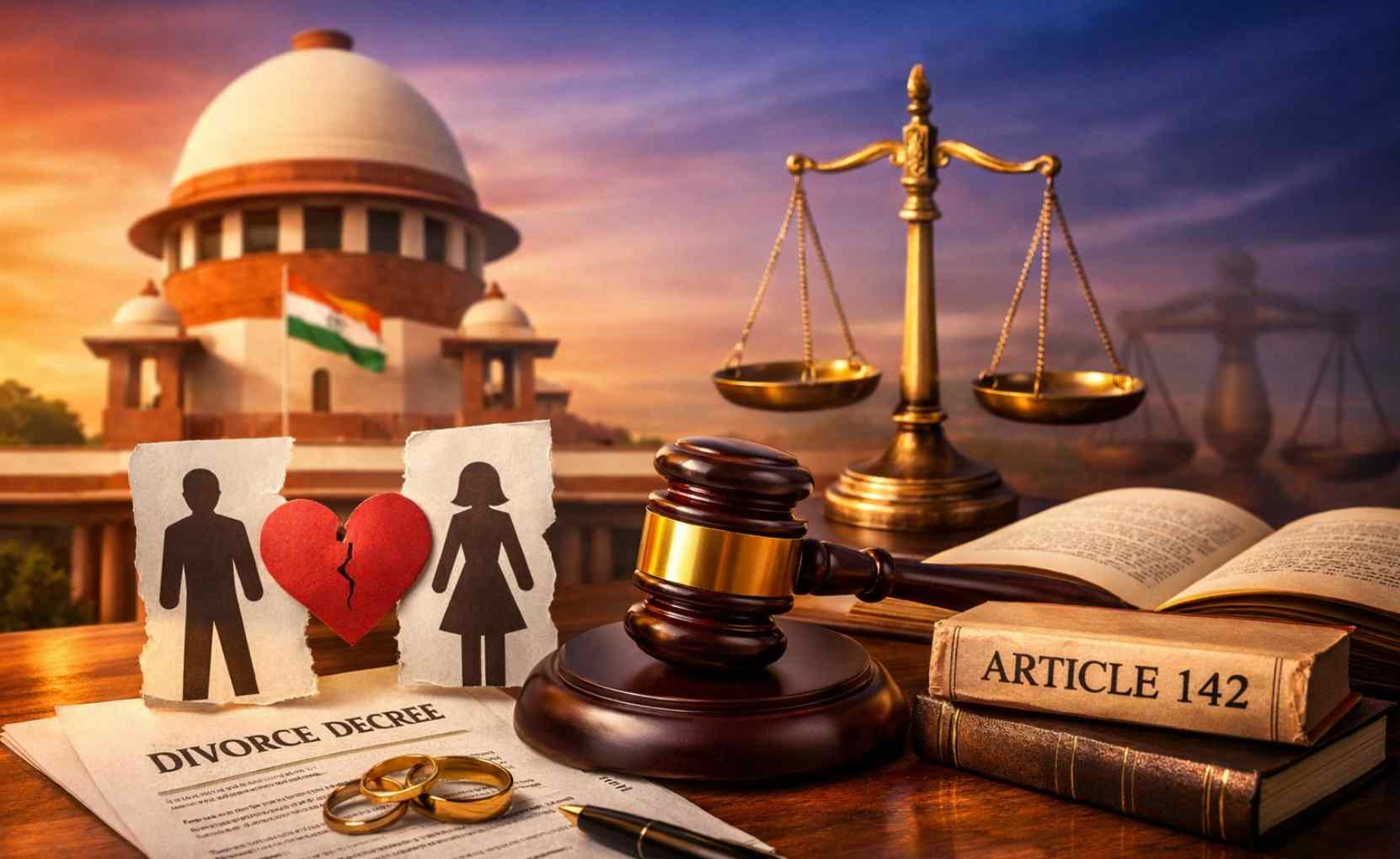
Courts Should Not Preserve A Dead Marriage: Supreme Court
Where a marriage has existed only in court records for decades due to endless litigation, separation of parties is legally and socially preferable, the Supreme Court has held.
The Court ruled that a marriage surviving only on paper due to prolonged litigation inflicts cruelty upon both spouses and deserves dissolution.
Delivering judgment on December 15, the Supreme Court dissolved a marriage where the husband and wife had lived apart for nearly 24 years, holding that long separation without any realistic hope of reconciliation itself amounts to cruelty.
Prolonged Separation Equals Cruelty To Both Spouses
The Court observed that when spouses remain separated for an exceptionally long period and refuse to accommodate each other, the marriage loses its substance and purpose.
In such cases, forcing parties to remain legally bound only prolongs suffering.
Relying on earlier rulings, the Court reiterated that marriage surviving only on paper due to prolonged litigation is not a relationship worth preserving.
Pendency of matrimonial cases for decades, the Court noted, merely keeps the marriage alive in name, not in reality.
Background Of The Case
The marriage between the parties was solemnised in the year 2000. The couple separated in November 2001 and have lived apart since then, with no children born from the wedlock.
The husband first sought divorce in 2003, which was dismissed as premature.
A second petition filed in 2007 resulted in a divorce decree on the ground of desertion by the Trial Court.
However, the Gauhati High Court reversed the decree in 2011, holding that the wife had sufficient cause to leave the matrimonial home.
This prompted the husband to approach the Supreme Court.
Fault Theory Not Relevant After Long Separation
Setting aside the High Court judgment, the Supreme Court held that it was unnecessary to assign blame after nearly 24 years of separation.
The Court clarified that when a marriage has collapsed beyond repair, fault becomes irrelevant.
The Bench held that marriage surviving only on paper due to prolonged litigation itself constitutes cruelty, warranting exercise of the Court’s power under Article 142 of the Constitution to do complete justice.
Article 142 Can Be Used To End Dead Marriages
Referring to Constitution Bench rulings, the Court reaffirmed that Article 142 empowers it to dissolve marriages even where statutory grounds may technically fall short.
The Court emphasised that matrimonial disputes are deeply personal and courts should not act as moral arbiters deciding which spouse is right or wrong.
Strongly held views and continued refusal to reconcile, when stretched over decades, result in mutual cruelty.
Supreme Court’s Final View
The Court concluded that no useful purpose would be served by keeping matrimonial litigation pending endlessly.
Severing ties, in such cases, is in the best interest of both parties and society at large.
Once again, the Supreme Court made it clear that marriage surviving only on paper due to prolonged litigation cannot be forced upon unwilling spouses in the name of legal formalism.
Case Details
- Case Title: N vs A
- Citation: CIVILAPPEAL NO. 5167 OF 2012
- Bench: Justice Manmohan, Justice Joymalya Bagchi
Follow The Legal QnA For More Updates…
CIVILAPPEAL NO. 5167 OF 2012