












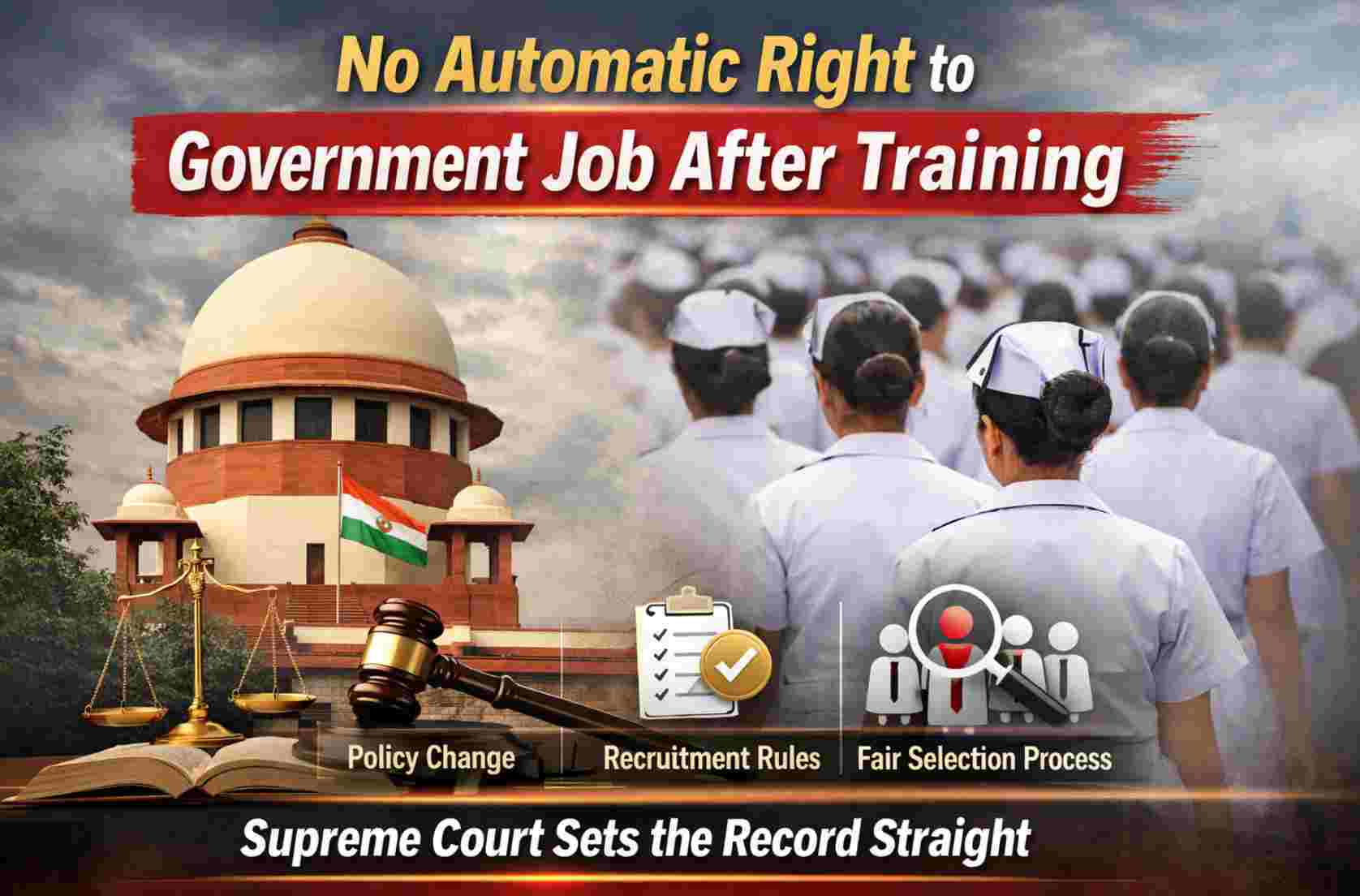
The Supreme Court of India has categorically held that mere admission to or completion of a government-run training course does not create any automatic or vested right to appointment in public service, even if such appointments were routinely made in the past.
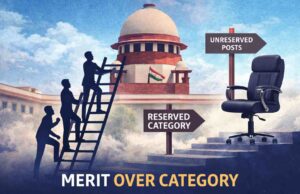
Setting aside the judgment of the Allahabad High Court, the Court ruled that claims based on legitimate expectation cannot override a clear change in government policy, statutory recruitment rules, or the requirement of a competitive selection process.
The ruling came in a batch of civil appeals filed by the State of Uttar Pradesh against candidates who had completed the Ayurvedic Nursing Training Course and sought direct appointment as Ayurvedic Staff Nurses.
The High Court had earlier accepted their plea, holding that past practice created a legitimate expectation of appointment.
The Supreme Court disagreed.
At the heart of the dispute was whether candidates who were admitted to a government Ayurvedic Nursing Training Course, at a time when most trainees were appointed after completion, could claim a legal right to appointment despite a subsequent policy shift, expansion of private training institutions, and a new statutory recruitment framework.
The Court answered this in the negative.
Training is not an appointment
Examining the admission advertisement and the governing government orders, the Bench noted that no promise of automatic appointment was ever made.
Clause 9 of the advertisement merely required candidates to execute a bond stating that
“after completion of training, in case the government selects any candidate for mandatory service, it shall be incumbent for the candidate to serve the State at least for a period of 5 years from the date of appointment.”
Interpreting this clause, the Court observed:
“It is not that the bond was applicable for all the candidates. It was only meant for the candidate selected for the government service.”
The Court emphasised that selection and appointment are distinct stages, and admission to a training programme does not collapse that distinction.
Change in Policy Is Decisive
The judgment traced the evolution of the policy landscape.
Until 2011, Ayurvedic Nursing Training was conducted only by a single government institution with an intake of 20 students.
Vacancies exceeded the number of trained candidates, and most trainees were appointed without much consideration.
However, after the government permitted private institutions to impart training, the situation changed dramatically. By 2019–20, nearly 311 institutions were conducting the course, resulting in a massive increase in trained candidates.
The Court recorded:
“Thus, the number of pass outs had far outnumbered the available vacancies. As a result, it was impossible to recruit all the pass outs.”
In this changed scenario, the Court held that continuing automatic appointments would not only be impractical but also discriminatory against candidates trained in private institutions.
Legitimate Expectation Has Limits
Rejecting the High Court’s reliance on the doctrine of legitimate expectation, the Supreme Court clarified that past practice cannot freeze government policy forever.
The Bench observed:
“It may be far-fetched to apply the principle of legitimate expectation to the case in hand as there was a change in policy and scheme of government.”
The Court further held that the earlier practice of appointment was context-specific, rooted in a time when seats were limited and vacancies abundant.
Once those foundational facts changed, the expectation lost its legitimacy.
Importantly, the Court underlined that legitimate expectation is not a legal right. Relying on Constitution Bench jurisprudence, it reiterated that the doctrine can only operate within the boundaries of Article 14 and cannot be invoked to compel the State to act contrary to law or policy.
No Article 14 Violation
The respondents had argued that denial of appointment amounted to discrimination under Article 14, especially since earlier batches had been appointed.
The Court firmly rejected this argument.
It noted that no candidate admitted after the 2010–11 session was given appointment under the old system, except a few cases in 2015, which were made strictly pursuant to court orders.
The judgment records:
“The respondent has failed to point out a single candidate from her own batch or subsequent batches who was directly appointed by the State.”
On this basis, the Court held that there was no unequal treatment of equals, and therefore no violation of Article 14.
Recruitment Must Follow Statutory Rules
Another crucial aspect of the ruling was the emphasis on statutory recruitment mechanisms.
The Court noted that after December 2014, recruitment to the post fell within the purview of the Uttar Pradesh Subordinate Services Selection Commission, and later, formal service rules were notified in 2021.
The Bench observed that once recruitment rules and a designated selection authority exist, appointments must strictly conform to them.
It held:
“The normal rule provides for a selection process to be followed so that the best available candidate is selected.”
Any direction to appoint candidates outside this framework, the Court warned, would undermine merit-based recruitment and administrative fairness.
Government College vs Private College Argument Rejected
The respondents had also contended that since they were trained in government institutions, they stood on a different footing from private college candidates.
The Court declined to accept this distinction.
It reasoned that appointing only government-trained candidates would lead to institution-based discrimination, especially when training standards were regulated by the same statutory framework.
The judgment noted that equality principles do not permit preferential treatment merely on the basis of the institution where training was undertaken.
High Court Direction Set Aside
Concluding that the High Court erred in directing the State to consider the respondents for appointment, the Supreme Court set aside the impugned judgment and allowed the appeals.
The Court held:
“The direction issued by the High Court mandating the State to consider the candidature of respondents for appointment… cannot be legally sustained.”
The ruling firmly reinforces the principle that government employment is not an entitlement flowing from training or past practice, but a privilege regulated by law, policy, and competitive selection.
Follow The Legal QnA For More Updates…