














Written by Adv. Raghav Menon, a senior civil lawyer with 20 years of dedicated practice across multiple states. His expertise lies in suits involving government authorities, contractual disputes, and administrative law. He enjoys sharing courtroom-tested insights that help newcomers understand procedural nuances and avoid common litigation pitfalls.
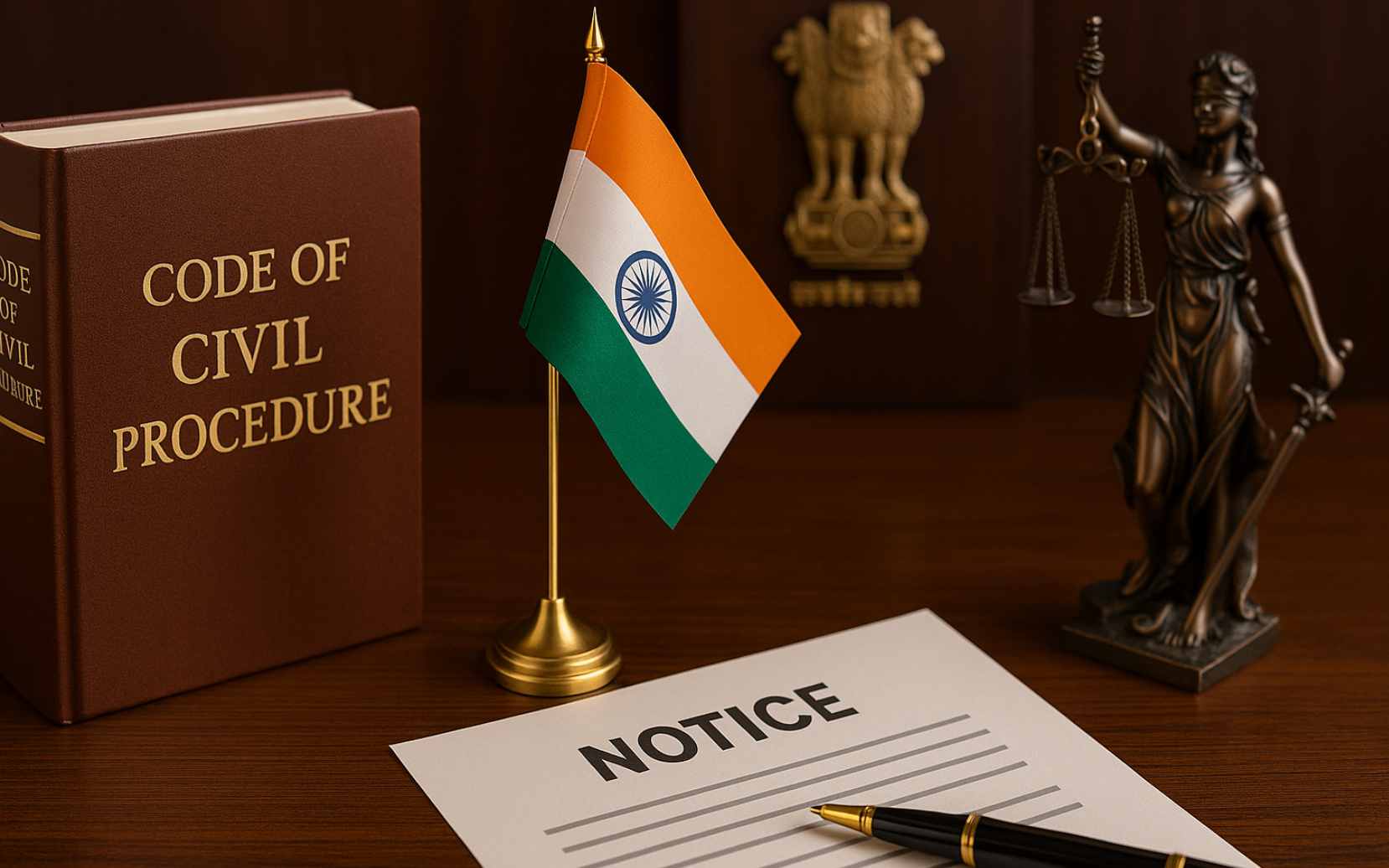
When a dispute arises involving the Government or a public officer, the law insists that one step must usually precede the filing of a civil suit, the statutory notice under Section 80 of the Code of Civil Procedure, 1908.
Having worked in civil litigation for two decades, I have seen countless matters falter only because the litigant or even the drafting counsel overlooked or mishandled this requirement.
Section 80 is simple in its intention, but any lapse in compliance can derail an otherwise strong case.
Why Does the Law Require a Notice to the Government?
Section 80 CPC is not a mere formality. Its purpose is to give the Government or the concerned public officer an opportunity to:
- understand the grievance,
- examine the claims,
- decide whether the matter can be settled without litigation, and
- avoid unnecessary suits.
In many cases, especially in revenue, railway, and administrative matters, a properly drafted notice often leads to settlement or at least clarifies the Government’s stand before the matter reaches court.
Mandatory Notice: Section 80(1)
- General Rule: Two-Months Prior Notice
No suit can be filed against:
- the Central Government,
- the Government of any State, including the former State of Jammu & Kashmir, or
- a public officer (for acts done in an official capacity),
unless a written notice is served two months before the suit.
Where Should the Notice Be Delivered?
The section is particular:
- Against Central Government (other than railway matters): Notice must be delivered to a Secretary to the Central Government.
- Against Central Government in railway matters: Notice to the General Manager of the railway concerned.
- Against State Government: Notice to the Secretary of the State Government or the District Collector.
- Against a public officer: Notice must be delivered to the officer personally or at his office.
A plaint filed without this notice is ordinarily not maintainable.
What Must the Notice Contain?
A well-drafted Section 80 notice should clearly state:
- Cause of action: What exactly is the grievance?
- Name, description and address of the plaintiff: So the Government can identify the claimant.
- Relief sought: The exact relief the plaintiff intends to claim in the suit.
The plaint itself must contain a statement confirming that the notice was duly served.
Exception: Urgent Relief (Section 80(2))
There are situations where waiting two months would defeat the very purpose of the suit, say, an illegal demolition drive, a sudden attachment, or illegal cancellation of a licence that affects livelihood.
For such matters, the law provides relief.
With Leave of the Court
A suit may be instituted without serving notice, but only after obtaining permission (leave) of the court.
However, even in urgent suits:
- The court must give the Government or officer a reasonable chance to show cause before granting any relief, even interim.
- If the court finds that urgent relief is not necessary, it must return the plaint so the plaintiff can serve notice and re-file.
This prevents misuse of the urgency clause.
Effect of Defects in the Notice: Section 80(3)
Courts no longer take a hyper-technical approach.
A suit will not be dismissed merely because the notice has some error, provided that:
- the Government or officer could clearly identify the plaintiff, and
- the notice substantially indicated the cause of action and relief.
This amendment was introduced to ensure justice is not defeated over minor drafting errors.
Practical Tips From Litigation Experience
Always attach proof of service
Courts frequently reject suits when plaintiffs cannot prove delivery of notice.
Use speed post with acknowledgment, email (if permitted), and physical delivery through a process server when possible.
Clearly mention in the plaint that Section 80 notice has been served
Omissions lead to objections even if the notice was in fact served.
In urgent matters, draft a separate application seeking leave under Section 80(2)
Courts expect clear reasons showing why delay of two months would cause harm.
Serve notice even in doubtful cases
When unsure whether the defendant is a “public officer” acting in an official capacity, it is safer to send the notice rather than risk dismissal.
Don’t assume that the Government will not respond
In several disputes, land acquisition compensation, pension matters, and contract claims, I’ve seen issues resolved simply because the notice prompted a departmental inquiry.
Landmark Supreme Court Judgments on Section 80 CPC
- Dhian Singh Sobha Singh v. Union of India, AIR 1958 SC 274: Substantial compliance with Section 80 is enough. The notice should not be construed with excessive technicality.
- Raghunath Das v. Union of India, AIR 1969 SC 674: A suit without notice is not maintainable unless it falls under Section 80(2). Leave of court is mandatory for urgent suits.
- Beohar Rajendra Sinha v. State of Madhya Pradesh, AIR 1969 SC 1256: The purpose of notice is to give the Government a chance to settle the claim. Minor defects in the notice do not invalidate the suit.
- State of A.P. v. Gundugola Venkata Suryanarayana Garu, AIR 1965 SC 11: Section 80 notice is mandatory and serves as an opportunity for the Government to reconsider its position before litigation.
- Bihari Chowdhary & Ors. v. State of Bihar, (1984) 2 SCC 627: A suit filed without notice under Section 80(1) is incompetent unless it strictly satisfies Section 80(2). Compliance is mandatory.
- Ghanshyam Dass v. Dominion of India, (1984) 3 SCC 46: Notice defects do not defeat the suit if the essential information (identity, cause of action, relief) is substantially conveyed.
- State of Kerala v. Sudhir Kumar Sharma, (2004) 1 SCC 243: The Government may waive the requirement of Section 80 notice if it does not object at the earliest stage.
- Amar Nath Dogra v. Union of India, AIR 1963 SC 424: The object of Section 80 is to give the Government an opportunity to examine the claim and avoid unnecessary litigation.
Conclusion
Section 80 CPC acts as a bridge between citizens and the State, encouraging resolution before litigation.
While mandatory in most cases, the law also recognizes that emergencies may not wait for procedural formalities.
A carefully drafted and properly served Section 80 notice not only satisfies a legal requirement but often strengthens the plaintiff’s position and leads to quicker, smoother judicial proceedings.
If handled correctly, it becomes the foundation of a well-prepared civil suit.
Follow The Legal QnA For More…