












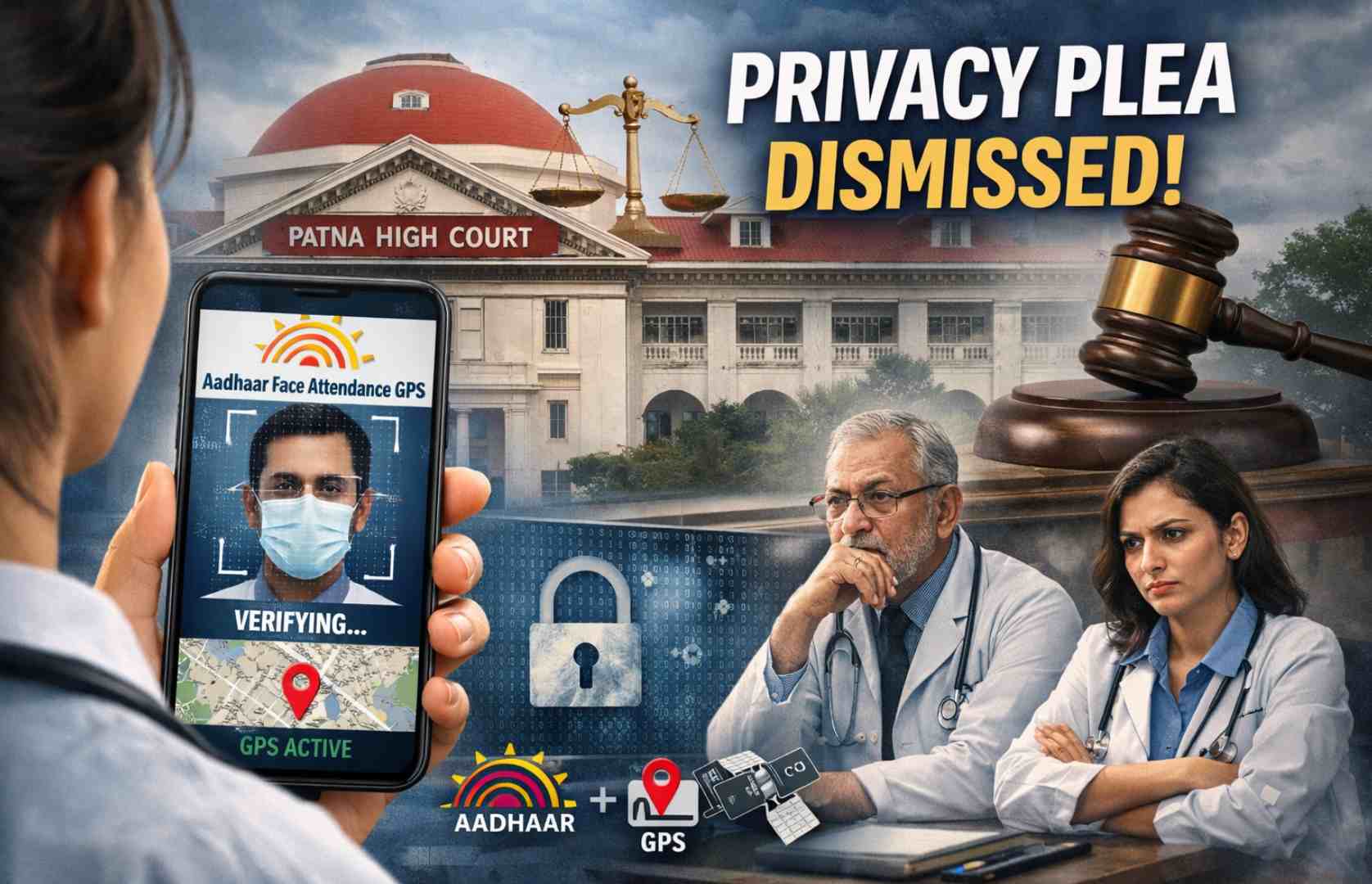
Aadhaar Face Attendance GPS has received judicial backing from the Patna High Court, as the Court dismissed a writ petition filed by medical faculty members from Bihar challenging the National Medical Commission’s direction mandating face-based Aadhaar authentication along with GPS-tagged attendance for faculty in medical colleges.
The matter arose from Civil Writ Jurisdiction Case No. 11111 of 2025, where the petitioners sought quashing of the NMC public notice dated 16 April 2025 and subsequent implementation directions issued by the State Health Department and the Principal of Sri Krishna Medical College and Hospital, Muzaffarpur. The judgment was delivered on 17 January 2026 by Honourable Mr. Justice Bibek Chaudhuri.
What Was Under Challenge in the Aadhaar Face Attendance GPS Case
The petitioners, being doctors serving as faculty members across various government medical colleges in Bihar, questioned the legality and constitutionality of a system requiring:
- Face based Aadhaar authentication for attendance marking
- GPS location sharing for attendance validation
- Attendance marking within a defined radius, stated to be 100 meters from the designated GPS point
The petition assailed the following communications:
- NMC public notice dated 16 April 2025 mandating Aadhaar Face Attendance GPS
- Office order Memo No. 1128/25 dated 21 April 2025 issued by the Principal, SKMCH Muzaffarpur
- Health Department letter No. 414(17) dated 30 April 2025 directing statewide implementation
Petitioners’ Stand: Privacy and Aadhaar Act Restrictions
The petitioners argued that compulsory Aadhaar Face Attendance GPS infringes the fundamental right to privacy and informational autonomy protected under Articles 14, 19, and 21 of the Constitution of India.
Relying upon the Supreme Court decisions in:
- K.S. Puttaswamy (Privacy) (2017) 10 SCC 1
- K.S. Puttaswamy (Aadhaar) (2019) 1 SCC 1
The petitioners asserted that Aadhaar authentication cannot be expanded beyond the statutory framework, especially Section 7 of the Aadhaar Act, which primarily concerns subsidies, benefits, and services.
They further contended that Aadhaar authentication is voluntary, and compelled biometric or face authentication without free consent is impermissible.
A serious objection was also raised on GPS-based monitoring being excessive surveillance, and the possibility of third party access through mandatory app installation.
NMC’s Defence: Attendance Reform for Governance and Accountability
The National Medical Commission filed a counter affidavit disputing the petitioners’ allegations and set out the regulatory history of Aadhaar-enabled attendance in medical institutions.
NMC relied upon multiple notifications and circulars, including earlier moves beginning in 2020, stating that the Aadhaar Enabled Biometric Attendance System was introduced due to shortcomings in older biometric modes.
The Commission justified Aadhaar Face Attendance GPS as a governance measure to ensure the physical presence of faculty, particularly in light of inspection findings indicating staff shortages and irregular attendance patterns.
State’s Submission: GPS Tagging Closed the “Remote Attendance” Gap
The learned Advocate General argued that faculty attendance systems existed earlier, but loopholes permitted marking attendance from locations far away from the workplace.
It was submitted that the controversy surfaced primarily after GPS tagging was introduced, as it restricted attendance marking to the institutional premises.
The Court was also invited to note that the petitioners did not plead any concrete instance of misuse of data or demonstrable harm, but proceeded largely on apprehension.
Patna High Court’s Findings: No Case Made Out for Interference
After hearing the parties, the Patna High Court declined to interfere and held that no sufficient ground was made out to invalidate the impugned measures.
The Court observed that:
- The NMC is a statutory body regulating medical education and standards
- Biometric attendance is already in force in medical colleges across the country
- Mere apprehension of privacy breach, without a specific pleaded case of violation, cannot justify constitutional writ relief
- Ensuring faculty presence is a legitimate regulatory goal tied to the functioning of medical education and healthcare delivery
The Court accepted the rationale that Aadhaar Face Attendance GPS was intended to strengthen compliance and curb attendance irregularities, especially in public institutions.
Case Law Noted by the Court on Biometric Attendance Systems
The judgment referred to judicial precedents supporting biometric attendance as a valid administrative measure, including:
- Supreme Court observations on authentication mechanisms for good governance
- Union of India v. Dillip Kumar Rout, Civil Appeal No. 13572 of 2015 decided on 29 October 2025, where implementation of biometric attendance was permitted
- Madras High Court decisions upholding Aadhaar enabled biometric attendance for teachers
- Delhi High Court’s view that attendance apps as a policy decision cannot be termed arbitrary unless clearly unlawful
Final Order: Writ Petition Dismissed, No Costs
The Patna High Court dismissed the writ petition on contest and declined to grant any of the reliefs sought by the petitioners. No costs were imposed.
At the same time, the Court recorded a crucial institutional observation: attendance enforcement alone cannot cure the larger crisis of vacant posts and staffing shortages in medical teaching services.
Directions to NMC: Fill Vacant Medical Teaching Posts
Though not directly arising from the pleadings, the Court directed the National Medical Commission to take appropriate action by advising State Governments to initiate recruitment drives to fill the large number of vacancies in medical teaching services within a time-bound period.
A copy of the judgment was directed to be sent to the Secretary, National Medical Commission, Ministry of Health and Family Welfare, Government of India, for implementation of the Court’s observation preferably within six months.
Case Details
- Case Title: Dr. Shyam Kumar Satyapal and Others vs The National Medical Commission and Others
- Court: High Court of Judicature at Patna
- Jurisdiction: Civil Writ Jurisdiction
- Case Number: CWJC No. 11111 of 2025
- Date of Judgment: 17 January 2026
- Coram: Honourable Mr. Justice Bibek Chaudhuri
- Result: Writ Petition Dismissed
- Costs: No order as to costs
Parties
Petitioners
- Dr. Shyam Kumar Satyapal
- Dr. Shashi Kapur
- Dr. Ajay Kumar
- Dr. Md. Abu Nasar
- Dr. Sanjay Kumar (Sitamarhi)
- Dr. Chandra Kishore Das
- Dr. Sanjay Kumar (Rajeev Nagar, Patna)
- Dr. Rakesh Ranjan
Respondents
- National Medical Commission through Chairman
- Chairman, National Medical Commission
- Secretary, National Medical Commission
- Union of India through Ministry of Health and Family Welfare
- Secretary, Ministry of Electronics and Information Technology
- State of Bihar through Additional Chief Secretary, Health Department
- Officer on Special Duty, Health Department, Bihar
- Principal, Sri Krishna Medical College and Hospital, Muzaffarpur
Bench Details
Single Judge Bench: Honourable Mr. Justice Bibek Chaudhuri
Follow The Legal QnA For More Updates…