













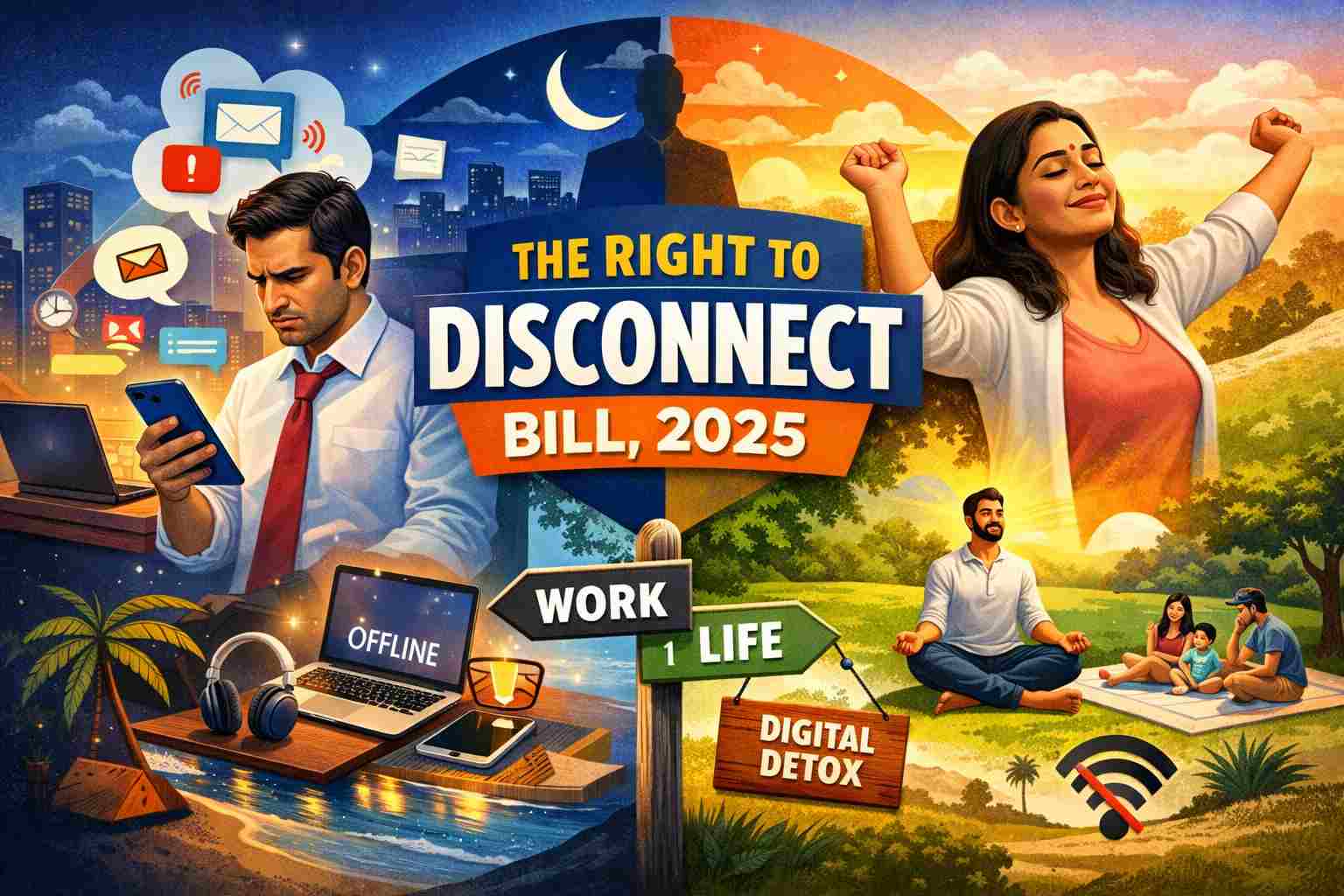
- Employees have a legal right to ignore work calls, messages, and emails outside agreed working hours without fear of punishment.
- Companies must clearly define work hours, after-hours contact rules, and overtime pay through mutual agreement with employees.
- Employees who work beyond normal hours are entitled to overtime wages, ending the culture of unpaid extra work.
- The Bill promotes work–life balance through employee welfare committees, counselling services, and digital detox initiatives.
Almost everyone who works with a phone knows this feeling. You are lying in bed, scrolling aimlessly, when a notification pops up. It is an email from work.
You tell yourself you will just read it, not reply. Five minutes later you are typing a response, your mind already racing about tomorrow. Work has followed you home again.
It is this everyday experience that the Right to Disconnect Bill 2025 is trying to address.
Introduced in the Lok Sabha by Supriya Sule, the Bill is built on a very simple idea. Employees deserve personal time that truly belongs to them.
Not borrowed time. Not time that can be interrupted at any moment. Just time to rest, recover, and live.
Why This Bill Feels So Timely
Technology has made work faster, easier, and more flexible. At the same time, it has quietly erased the line between office hours and personal life.
Phones buzz during dinner. Emails arrive on weekends. Messages show up during holidays. Even when employees are not actively working, they feel mentally tied to work.
This constant connection has a cost. Studies mentioned in the Bill point to stress, sleep problems, emotional exhaustion, and declining productivity.
The more people are expected to be available all the time, the less effective they actually become. The Bill recognises that overwork does not equal better work.
In human terms, it acknowledges something workers have been saying for years. Being reachable all the time does not make you dedicated. It makes you tired.
What the Right to Disconnect Actually Means
At the core of the Bill is the right of every employee to disconnect outside agreed working hours. This does not mean employers are completely banned from contacting employees after work hours. It means employees are not forced to respond.
If an employee chooses not to answer a call, message, or email after work hours, that silence cannot be treated as misconduct. There can be no punishment, no negative marking, and no quiet retaliation.
This single provision changes the balance of power. It turns availability from an obligation into a choice.
Creating a System That Supports Employees
The Bill does not rely only on goodwill. It proposes the creation of an Employees Welfare Authority at the national level.
This authority would study how digital tools are being used, especially outside work hours, and help design policies that protect employees while keeping workplaces functional.
Instead of assuming all industries work the same way, the Bill accepts diversity in work cultures.
A newsroom, a factory, and a software company operate differently. The law creates a framework and leaves room for negotiation within that framework.
Company Charters and Mutual Agreements
Rather than forcing a single rule on everyone, the Bill requires companies and societies with more than ten employees to create their own Charters.
These Charters are to be negotiated with employees or their representatives.
Each Charter must clearly explain what counts as work hours, what counts as out of work hours, and when employees can be contacted. The idea is transparency. No hidden expectations. No unwritten rules.
When expectations are written down and mutually agreed, employees can plan their lives better and employers can plan their work better.
Overtime Must Be Paid
One of the most important parts of the Bill deals with overtime. If an employee agrees to work beyond normal hours, they must be paid overtime at their regular wage rate.
This is especially important in a digital economy where unpaid overtime has become common.
Many employees today work extra hours without even realising it because the work comes through messages and emails rather than formal shifts.
The Bill sends a clear message. Extra work deserves extra pay.
Recognising the Reality of Remote Work
Remote work and work from home arrangements receive special attention. The Bill requires organisations to frame separate policies for employees who work remotely, travel for work, or rely heavily on digital communication.
These policies must be mutually agreed upon. This ensures that flexibility does not turn into exploitation. Just because someone works from home does not mean they are available all the time.
The Bill also encourages awareness programmes to teach employees and employers about responsible use of digital tools.
Digital Detox and Mental Well Being
One of the most unusual and human aspects of the Bill is its focus on mental health. It proposes counselling services to help employees maintain balance between work and personal life.
It also talks about setting up digital detox centres.
This is an acknowledgment that the problem is not only about office rules. It is about habits, pressure, and constant stimulation.
Sometimes people need help learning how to switch off, even when they are allowed to.
Consequences for Ignoring the Law
The Bill is firm about enforcement. Companies and societies that fail to follow its provisions or their own Charters can face financial penalties amounting to one percent of total employee remuneration.
What This Bill Represents
The Right to Disconnect Bill 2025 is not anti work and it is not anti growth. It is pro balance. It recognises that productivity and rest are not enemies. In fact, they depend on each other.
The Right to Disconnect Bill speaks to something deeply personal rather than purely legal. It recognises that people are more than job titles and more than unread notifications.
Rest is not laziness and silence is not disobedience. By giving employees permission to step away without fear, the Bill tries to restore dignity to everyday work life. It does not promise perfect balance, but it opens the door to healthier habits and fairer expectations.
If taken seriously, it can change how work feels at the end of the day, calmer, clearer, and more human.
Follow The Legal QnA For More Updates…