













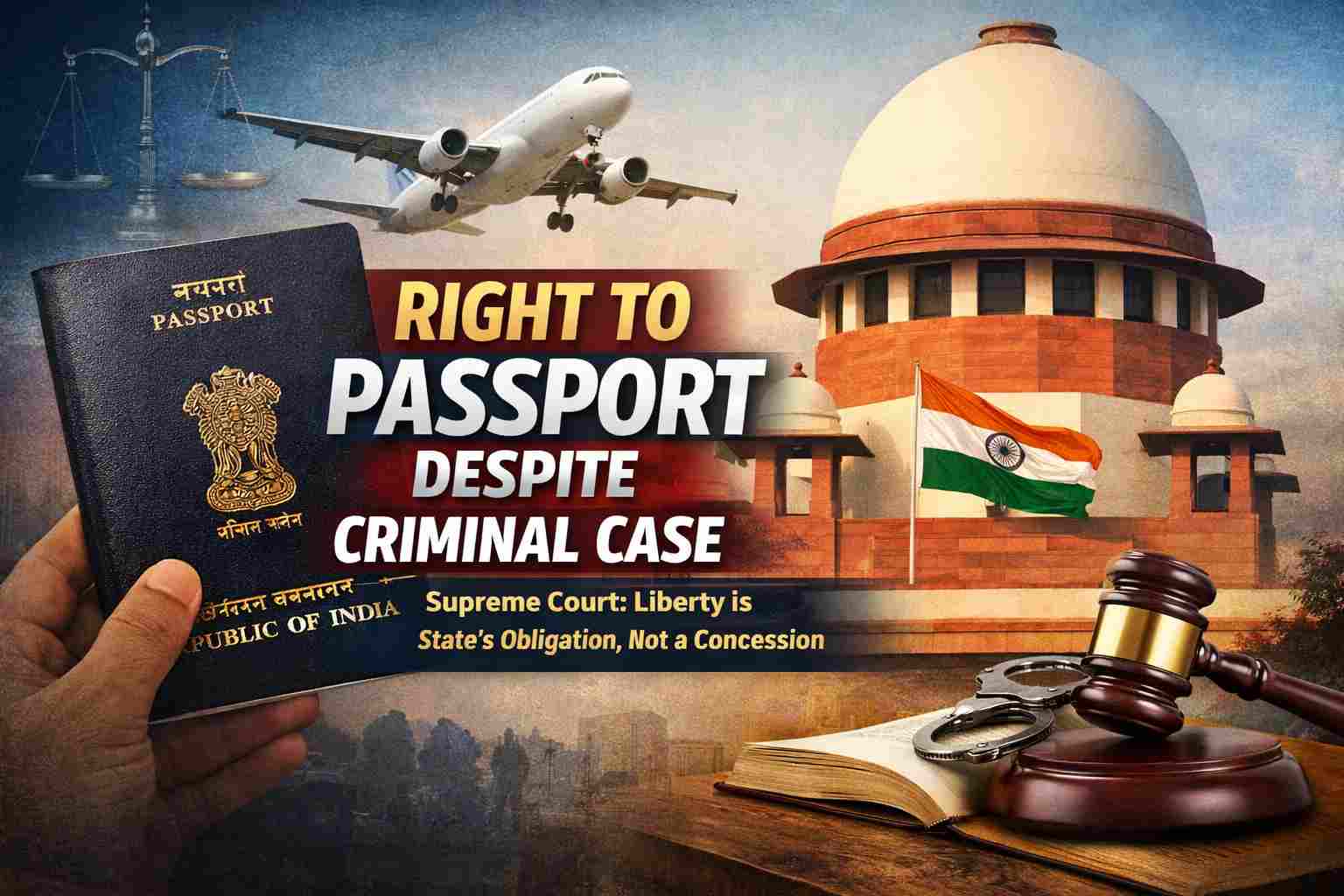
Liberty under the Indian Constitution is not a concession extended by the State but a binding obligation cast upon it, the Supreme Court has held while reaffirming that the right to a passport despite a criminal case remains protected unless lawfully and proportionately restricted.
A Bench of Justice Vikram Nath and Justice A G Masih clarified that the mere pendency of criminal proceedings does not automatically disentitle a citizen from renewal or issuance of a passport.
The Court cautioned that when procedural safeguards are transformed into inflexible barriers, the constitutional balance between State authority and individual dignity is imperilled.
The observations were made while deciding an appeal filed by Mahesh Kumar Agarwal, whose passport had expired in August 2023.
Agarwal stands convicted in a coal block allocation case investigated by the CBI and is also facing prosecution in a separate coal mining matter under the Unlawful Activities Prevention Act before the NIA Court at Ranchi.
While the NIA Court had permitted the release of Agarwal’s passport for the limited purpose of renewal, subject to the deposit of the renewed document and restriction on foreign travel without prior leave, the Delhi High Court had also granted a no-objection certificate for renewal of the passport for ten years after suspending his sentence in the CBI case.
Despite these judicial permissions, the Regional Passport Office, Kolkata, declined renewal citing Section 6(2)(f) of the Passports Act, 1967, on the ground that criminal proceedings were pending. The Calcutta High Court upheld this refusal, prompting the appeal before the Supreme Court.
The Supreme Court rejected this approach, reiterating that Section 6(2)(f) does not operate as an absolute bar. The Bench held that where a criminal court has applied its mind and consciously permitted issuance or renewal of a passport, subject to conditions, the passport authority cannot override such judicial determination.
The Court explained that the statutory framework draws a clear distinction between possession of a valid passport and the act of travelling abroad. A passport is a civil document that merely enables its holder to seek visas and cross borders, subject always to permissions imposed by competent courts.
Insisting that a criminal court must simultaneously approve a specific foreign journey for passport renewal, the Bench held, was a legally flawed reading of the law. Courts may allow renewal while retaining full supervisory control over each instance of foreign travel.
The Supreme Court further observed that speculative apprehensions regarding misuse of a passport amount to second guessing judicial discretion and result in passport authorities assuming a supervisory role not contemplated by law.
Emphasising that constitutional liberty cannot be reduced to administrative suspicion, the Court directed the passport authorities to re issue an ordinary passport to Agarwal for a full period of ten years, subject to all existing and future orders of the NIA Court at Ranchi and the Delhi High Court.
Concluding, the Bench underscored that the right to a passport despite criminal case flows from Article 21 of the Constitution and can only be regulated in a manner that is lawful, proportionate, and narrowly tailored to serve legitimate State interests.
Case Details
- Case Title: Mahesh Kumar Agarwal vs Union of India
- Court: Supreme Court of India
- Bench: Justice Vikram Nath and Justice A G Masih
- Appellant: Mahesh Kumar Agarwal
- Respondent: Union of India
- Appellant Counsel: Senior Advocate Gopal Subramanium
- Respondent Counsel: Additional Solicitor General Aishwarya Bhati
Follow The Legal QnA For More Updates…