











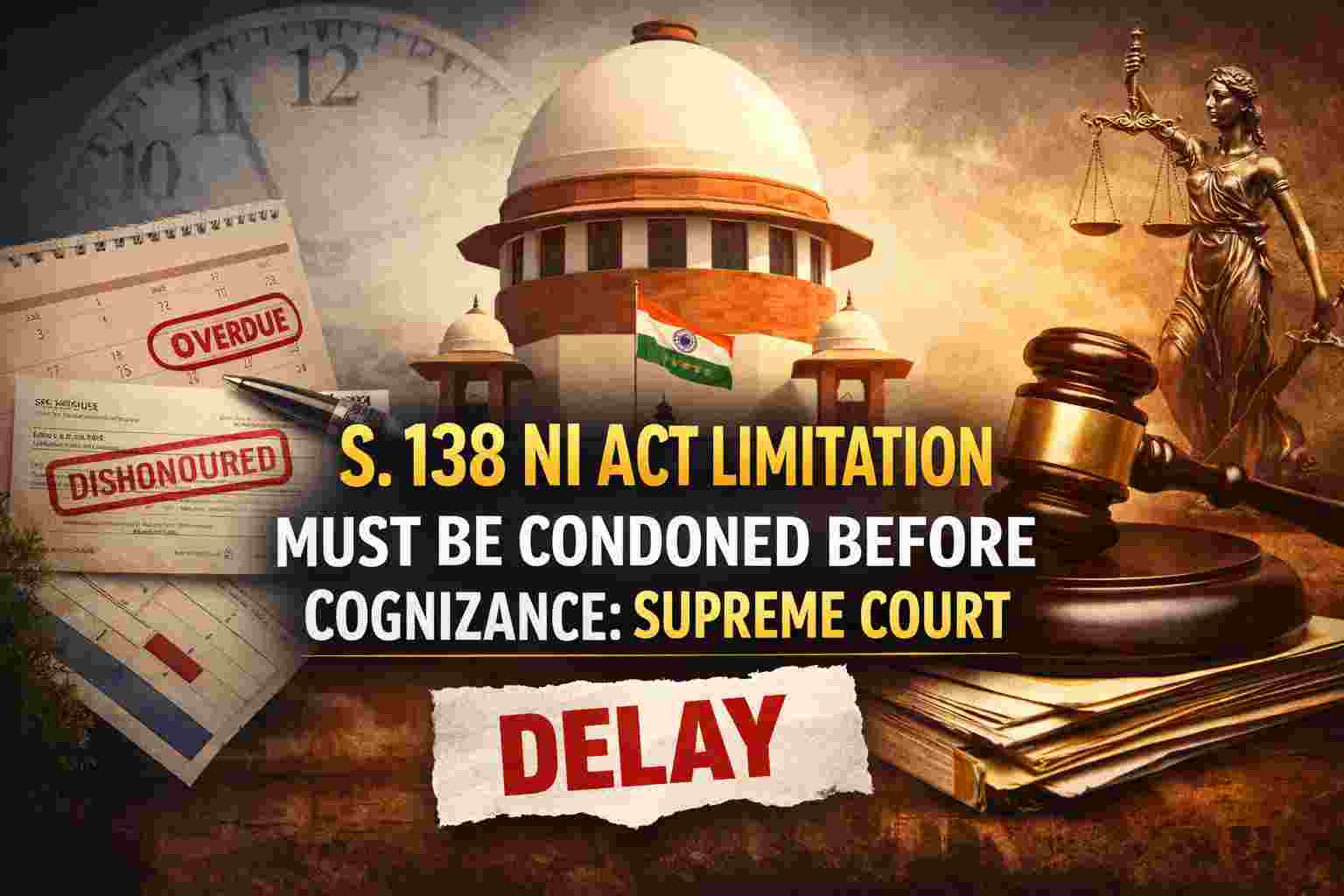
The S. 138 NI Act limitation regime has been authoritatively clarified by the Supreme Court of India, holding that a Magistrate has no jurisdiction to take cognizance of a time-barred cheque dishonour complaint unless the delay is condoned beforehand.
Any cognizance taken before such condonation is legally void and non est.
A Bench comprising Justice Sanjay Kumar and Justice Alok Aradhe set aside the judgment of the Karnataka High Court, which had treated premature cognizance in a cheque dishonour case as a curable irregularity.
The Supreme Court categorically rejected this approach, terming it a jurisdictional error.
Factual Matrix of the Cheque Dishonour Dispute
The controversy arose from an alleged loan transaction of ₹5.40 lakh. A cheque dated 10 July 2013 was dishonoured on 17 July 2013. After issuance of the statutory demand notice, the cause of action under S. 138 NI Act crystallised in August 2013.
However, the complaint was instituted on 9 October 2013, beyond the statutory limitation of one month prescribed under Section 142(1)(b) of the Negotiable Instruments Act. Despite this delay, the Magistrate proceeded to take cognizance immediately and condoned the delay almost five years later on medical grounds.
Supreme Court on S. 138 NI Act Limitation
While allowing the appeal, the Supreme Court held that the proviso to Section 142(1)(b) mandates prior satisfaction of sufficient cause before a belated complaint can even enter the court’s jurisdiction.
The Court observed that a complaint suffering from limitation cannot be treated as a valid proceeding until the delay is formally condoned.
The Court underscored that condonation of delay is a condition precedent, not a procedural formality that can be deferred.
Taking cognizance first and condoning delay later was held to be contrary to the express statutory scheme governing S. 138 NI Act limitation.
Jurisdictional Defect, Not a Curable Irregularity
Rejecting the High Court’s reasoning, the Supreme Court clarified that this was not a defect curable under criminal procedure.
Since the complaint was time-barred on the date cognizance was taken, the Magistrate lacked inherent jurisdiction.
A subsequent order condoning delay could not retrospectively validate an action that was void at inception.
The Court emphasised that limitation-linked complaints do not assume the character of regular proceedings unless and until the delay is condoned.
Any contrary approach would defeat the legislative intent behind Section 142 of the NI Act.
Outcome
The appeal was allowed, the proceedings were quashed, and the complaint was held to be non-maintainable due to the absence of valid cognizance under S. 138 NI Act limitation principles.
Case Details
- Case Title: S. Nagesh vs Shobha S. Aradhya
- Court: Supreme Court of India
- Bench: Justice Sanjay Kumar and Justice Alok Aradhe
- Citation: 2026 LiveLaw SC 13
Follow The Legal QnA For More Updates…