













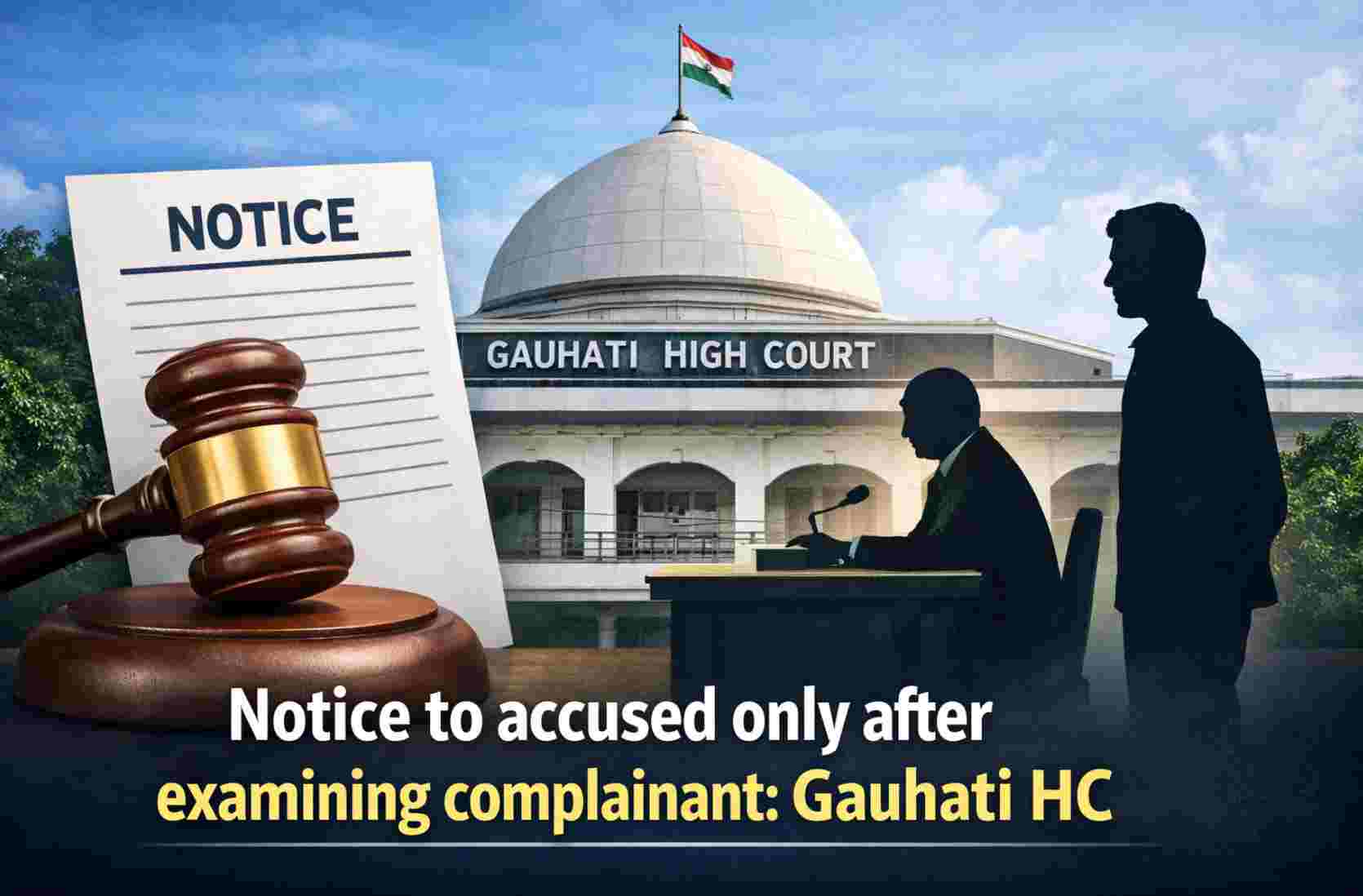
The Gauhati High Court has clearly ruled that a Magistrate cannot issue notice to an accused person before examining the complainant and witnesses on oath in a complaint case under the Bharatiya Nagarik Suraksha Sanhita, 2023 (BNSS).
The Court held that the accused has a right of hearing only after such examination and strictly before the stage of taking cognizance.
What the case was about
The ruling came while deciding two connected criminal petitions filed by Bhupendra Choudhury and Biswajit Choudhury, who had challenged proceedings pending before the Judicial Magistrate First Class, Morigaon.
The proceedings arose from two complaint cases filed by Arun Choudhury and Adhir Das, alleging offences under various provisions of BNSS.
The dispute between the parties primarily related to land possession at village Jhargaon in Morigaon district. A civil title suit concerning the same land was already pending before the civil court.
Issue before the High Court
The main question before the High Court was
whether a Magistrate can issue notice to the accused under Section 223 BNSS without first recording the statement of the complainant and witnesses on oath.
The petitioners argued that the Magistrate had issued notices mechanically, without following the mandatory procedure laid down under the new criminal law.
Court’s interpretation of Sections 223 and 226 BNSS
The Court closely examined Section 223 BNSS, which introduces a new proviso stating that no cognizance shall be taken without giving the accused an opportunity of being heard.
The Court clarified that this opportunity does not arise at the time of filing the complaint.
It was held that the correct sequence under BNSS is:
- First, the Magistrate must examine the complainant and witnesses on oath
- After such examination, the Magistrate may dismiss the complaint under Section 226 BNSS if no sufficient ground exists
- Only if the complaint survives this stage, notice must be issued to the accused
- Thereafter, cognizance can be taken following the accused’s limited hearing
Issuing notice before examining the complainant defeats the purpose of Section 226 and leads to unnecessary involvement of the accused.
Orders passed by the Court
The High Court found that the Magistrate, Morigaon had issued notices dated 21 February 2025 without examining the complainants.
Holding this to be contrary to law, the Court quashed the notice orders in both complaint cases.
The matters were remanded back to the trial court with directions to proceed afresh strictly in accordance with Sections 223 and 226 of BNSS, 2023.
Verdict
This judgment provides much-needed clarity on the complaint procedure under the new BNSS regime.
It protects individuals from premature summoning and reinforces that criminal law should not be used casually, especially where civil disputes are pending.
The Gauhati High Court has thus drawn a clear procedural boundary for Magistrates handling private complaints under BNSS.
Case details
- Court: Gauhati High Court
- Bench: Justice Anjan Moni Kalita
- Date of Judgment: 15 December 2025
- Criminal Petitions: Crl. Pet. No. 1126 of 2025 and Crl. Pet. No. 1127 of 2025
Parties
- Petitioners: Bhupendra Choudhury and Biswajit Choudhury
- Respondents: Arun Choudhury and Adhir Das
Follow The Legal QnA For More Updates…