


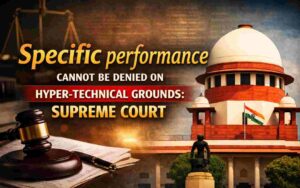


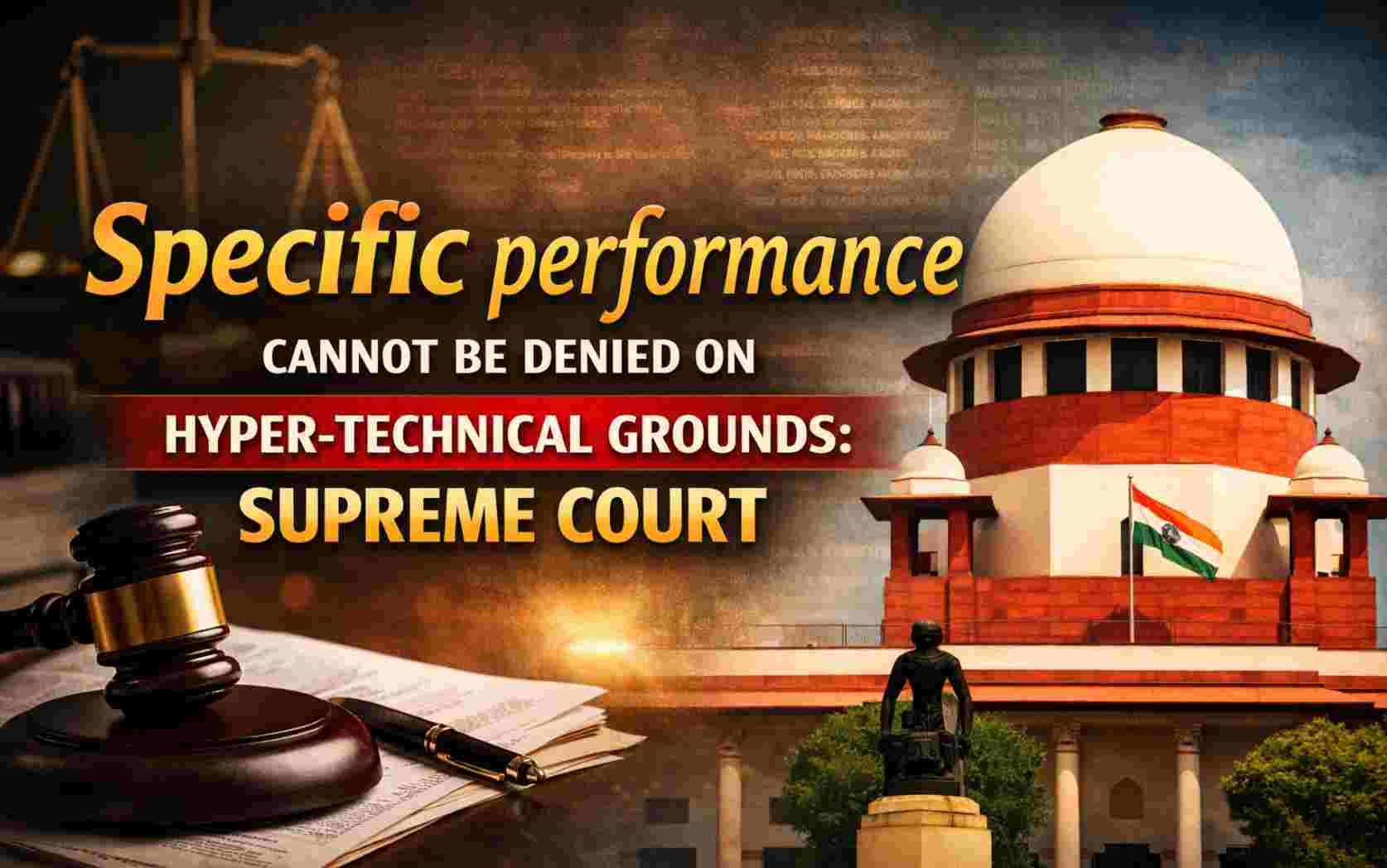
Courts exist to advance justice, not to reward obstruction through technical manoeuvring. Reaffirming this principle, the Supreme Court has held that specific performance cannot be denied on hyper-technical grounds, particularly when the conduct of the parties clearly demonstrates consent, ratification, and continuity of contractual obligations.
The judgment arose from a long-standing property dispute where a bona fide purchaser was denied relief by the trial court and the High Court on grounds of limitation and alleged lack of readiness and willingness.
The Supreme Court reversed these findings, restoring the suit for specific performance and setting aside what it described as an erroneous and inequitable approach.
Affidavit treated as binding admission
The Court examined the conduct of the defendant, especially the execution of a sworn affidavit expressly ratifying earlier acts of the power of attorney holder and conveying no objection to transfer of ownership.
This affidavit, the Court held, was not a casual document but a clear and conscious affirmation binding the executant.
Once such ratification was on record, the Court ruled that limitation could not be computed mechanically from earlier dates.
Instead, limitation commenced from the point of final refusal, which in this case followed the affidavit itself. On this reasoning, the suit was held to be well within time.
The Court made it clear that specific performance cannot be denied on hyper-technical grounds when documentary admissions remain unchallenged and the party executing them avoids the witness box.
Readiness and willingness are assessed through real conduct
Rejecting the High Court’s findings, the Supreme Court observed that readiness and willingness under the Specific Relief Act must be assessed through actual conduct and surrounding circumstances.
The purchaser had paid substantial consideration, obtained extensions consensually, and completed the transaction with all other co-sharers.
The refusal by one co-sharer, after ratifying the transaction and accepting its benefits, was held to be unjustified.
The Court emphasised that equity does not permit a party to approbate and reprobate at convenience.
Technical objections cannot defeat equity
The argument that an unregistered power of attorney stood automatically revoked was also rejected.
The Court held that subsequent ratification cures prior defects and validates acts done on behalf of the principal. Once ratified, the authority stands confirmed in law.
The Supreme Court cautioned that technical objections relating to form cannot override substantive justice, particularly in property transactions involving long-standing possession, public institutions, and statutory requirements.
Supreme Court grants specific performance
Allowing the appeal, the Court decreed specific performance in favour of the purchaser for the remaining share in the property.
The trial court was directed to determine the balance consideration with interest and ensure execution of the sale deed.
The connected appeal concerning management of the educational institution was also allowed, restoring full control to the purchaser in view of compliance with statutory land requirements.
Case Details
- Case Title: Muslimveetil Chalakkal Ahammed Haji v. Sakeena Beevi
- Court: Supreme Court of India
- Date of Judgment: 7 January 2026
- Nature of Case: Specific performance of agreement to sell
- Appeal Numbers: Civil Appeal Nos. 3894 and 3895 of 2022
Follow The Legal QnA For More Updates…