










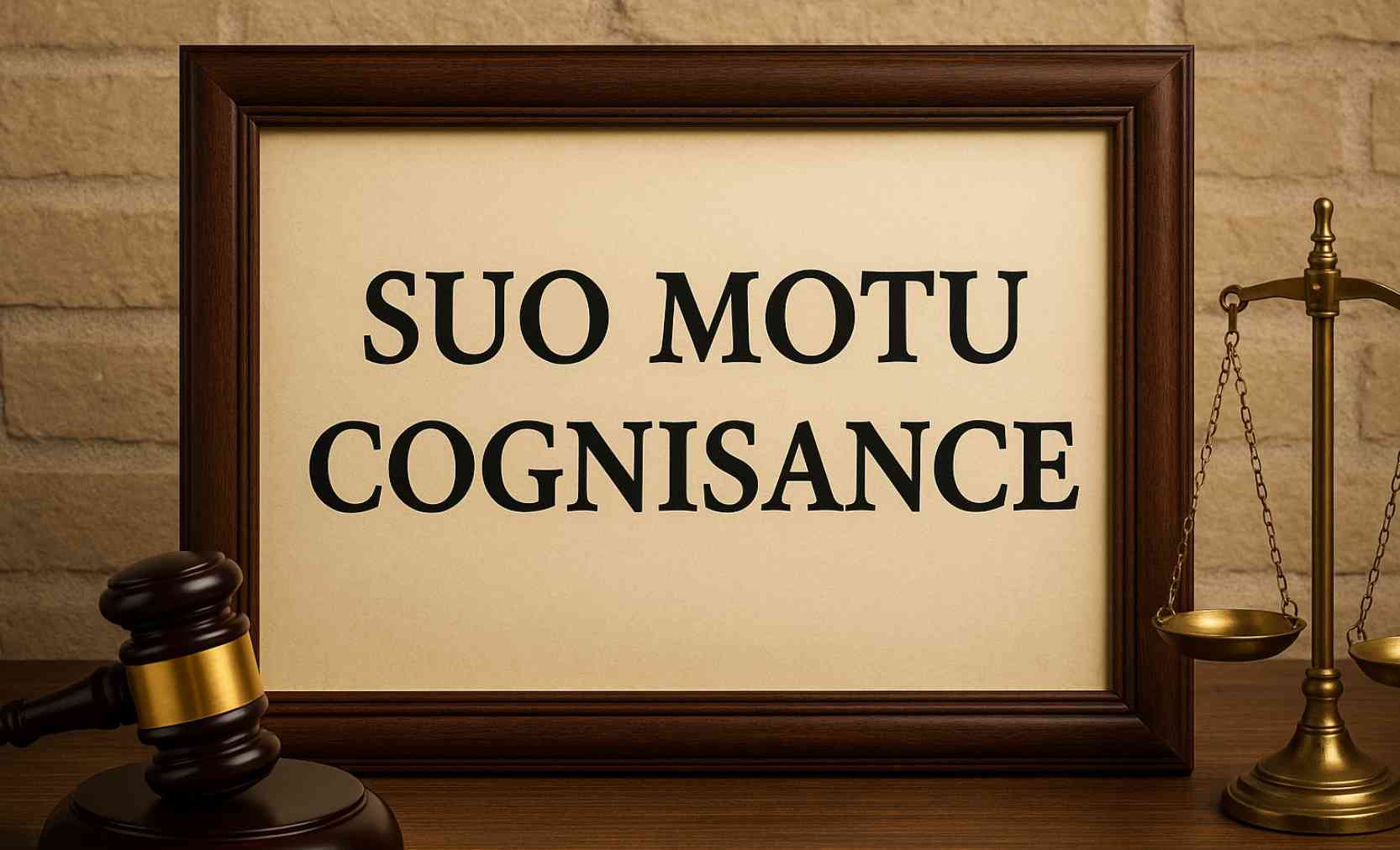
Suo Motu Cognisance refers to a court’s power to initiate legal action on its own, without any formal complaint or petition. It allows the judiciary to address matters of public interest, human rights, or government inaction when immediate judicial intervention is necessary for justice.
There is a peculiar power in silence. In the silence of a courtroom, the air often waits for someone to speak, for a petition to be filed, for a grievance to find its shape in legal language. Yet sometimes, the silence itself becomes unbearable.
The court does not wait for words to be spoken. It rises and says, this cannot wait for procedure. This cannot wait for someone to find the courage to complain.
That moment, when the court stirs from within and acts on its own awareness, is what the law calls suo motu cognisance.
The expression comes from Latin. Suo motu means “on its own motion.” Cognisance means to take notice of something.
Together, they describe a judicial act that begins not with a citizen, not with a government agency, not even with a lawyer, but with the court itself.
It is the judiciary saying, we see something wrong, and we will not pretend not to see it simply because nobody has yet filed a case.
The phrase might sound ancient, but its spirit is modern and humane. It is rooted in the idea that justice is not merely a service that waits to be requested.
It is a living obligation of the state to uphold rights, even for those too powerless or voiceless to assert them.
In India, this power has become one of the most fascinating features of the constitutional system. It has been both celebrated and criticized, but no one can deny that it has shaped the moral authority of the courts in extraordinary ways.
The Origins of a Self-Moving Court
The Indian Constitution does not contain the words “suo motu cognisance.” There is no clause that directly grants this power.
Yet, over the years, it has come to exist through interpretation and through the broad principles of justice written into the Constitution itself.
The Supreme Court, under Article 32, has the duty to enforce fundamental rights. Article 142 gives it the authority to pass any order necessary to do complete justice.
High Courts enjoy similar power under Article 226. These provisions give the judiciary a vast field of discretion, and within that field, suo motu action has grown naturally.
But the true origin of this idea lies not in legal text but in the moral awakening of the judiciary during the late 1970s and 1980s.
That was the era when the Indian courts began to expand the reach of Public Interest Litigation.
Before that time, a court could hear a case only if the person bringing it was directly affected by the issue.
If your neighbour’s rights were violated, you could not speak for them. The rule of locus standi acted like a locked door.
Then came a new vision. Judges began to ask what would happen to the rights of those who could not read or write, who did not know the language of law, who could barely afford food let alone a lawyer.
Could their rights simply be allowed to vanish in silence? The courts decided that such rigidity would defeat the very purpose of the Constitution.
They began to accept letters, newspaper reports, even scribbled notes sent by social workers or journalists as valid petitions.
This practice came to be known as epistolary jurisdiction, justice by letter. And once the court could act on a letter, it was only a small step further to say that the court could act on its own if it became aware of injustice.
That is how suo motu cognisance emerged. Not from a statute or a single judgment, but from a long process of empathy turning into law.
The Meaning in Motion
When a court takes suo motu cognisance, it does something remarkable. It steps out of the passive role of an umpire and momentarily becomes an initiator.
Normally, the justice system works like a mirror. Someone comes, presents a grievance, and the court reflects upon it through the rules of law.
But when the court takes notice on its own, it becomes more like a searchlight that scans the horizon for wrongs that have gone unnoticed.
This power is not limited to any one kind of issue. The courts have used it in matters of human rights, environmental degradation, corruption, contempt of court, and administrative failure. Sometimes the trigger is a newspaper article.
Sometimes it is a report from a commission or a shocking event witnessed by the judges themselves.
Once the court takes notice, it registers a case in its own name. It then asks for responses from the government or relevant authorities, appoints committees, monitors investigations, and issues directions as needed.
Over the years, the Indian judiciary has used this tool in many significant situations. When newspapers reported inhuman conditions in jails, the Supreme Court took cognisance and began a series of prison reform decisions.
When air pollution in Delhi reached dangerous levels, the court acted on its own to push for environmental regulation. During the COVID-19 pandemic, the Supreme Court and several High Courts initiated suo motu proceedings to ensure the availability of oxygen, essential medicines, and fair treatment for migrant workers.
At its best, this power acts like a safety valve in the machinery of democracy. It ensures that when every other institution falls asleep, there remains at least one voice awake to guard the spirit of justice.
The Moral Weight of the Power
Every extraordinary power comes with extraordinary responsibility. Suo motu cognisance is no exception. When a court decides to intervene on its own, it must walk a very thin line between vigilance and overreach.
On one hand, the public welcomes a judiciary that does not wait for permission to protect the helpless. On the other, there is a danger that too much enthusiasm can blur the separation of powers that the Constitution carefully builds.
The criticism is not entirely unfounded. Critics say that when the judiciary acts suo motu too often, it risks becoming a policy-maker rather than an interpreter of law.
It begins to perform the role of the executive, directing how roads should be cleaned or how oxygen cylinders should be distributed. The intention may be noble, but it raises a constitutional question: who guards the guardian?
Judges themselves have been aware of this tension. Many have spoken about the need for restraint. Suo motu power, they have said, must be exercised rarely and only when there is a genuine vacuum of action.
It is meant for moments when fundamental rights are in danger and there is no other practical way to rescue them. The court must not act as a daily supervisor of government administration, because that would distort the balance between the branches of the state.
Yet, when exercised wisely, this power can be transformative. It has compelled governments to wake up from apathy. It has given dignity to those who could not speak for themselves.
It has created new legal principles and even inspired reforms in governance. It is a reminder that the judiciary is not just a dispenser of verdicts but also a moral institution that holds the conscience of a nation.
The Human Face of Suo Motu Action
Beyond the language of law, there lies something deeply human in this concept. Imagine a judge reading a newspaper report about a child dying of hunger or a village living under poisonous industrial waste.
Imagine that judge realizing that no one will file a case because those affected do not even know what a petition is. In that moment, the judge becomes not just a reader but a witness. The power of suo motu cognisance gives that witness the authority to act.
There is an unspoken empathy built into this power. It acknowledges that justice cannot always be summoned by the victims themselves.
Sometimes justice must travel to them. It is the law bending towards compassion, the Constitution reaching down to the ground it promised to protect.
A Tool of Transformation and its Future
In the decades since independence, India’s courts have often been the last refuge of public hope. Governments have changed, legislatures have faltered, but the judiciary has continued to carry a certain moral authority.
Suo motu cognisance has been one of the reasons why. Through this power, the courts have stretched the meaning of justice beyond the four corners of a petition.
However, as India’s democracy matures, the use of this power must also evolve. The judiciary now faces an enormous backlog of cases.
Every time a court takes up a suo motu matter, it must dedicate resources and time that could otherwise go to pending litigation.
There is a growing recognition that suo motu actions should be guided by clear principles: urgency, public interest, and the absence of any other remedy.
Perhaps what is needed now is a formal framework that defines when and how suo motu cognisance should be taken.
Such a framework would not diminish the court’s independence but would make its interventions more transparent and consistent.
It would prevent the misuse of this tool for political or populist ends and preserve its sanctity for situations that truly demand immediate judicial awakening.
Verdict: When Justice Becomes Its Own Witness
In the end, suo motu cognisance is not merely a legal mechanism. It is a statement about the nature of justice itself.
It says that law cannot be blind to suffering just because no one has learned how to cry in the language of petitions. It says that there are times when the system must move without being pushed, when the guardians of law must act without being summoned.
This power reminds us that the judiciary is not just a structure of rules but also a living institution of conscience. It teaches that justice is not only about settling disputes but also about preventing silence from becoming complicity.
Suo motu cognisance is, at its heart, a moral decision dressed in legal authority. It carries both risk and responsibility.
But in a country as vast and varied as India, where inequality often mutes the voices of the weak, it remains a precious instrument. When used wisely, it becomes the heartbeat of a judiciary that still listens for the cries that no one else can hear.
That, perhaps, is what makes it so enduring. It is justice that refuses to wait.
Follow The Legal QnA For More Updates…