











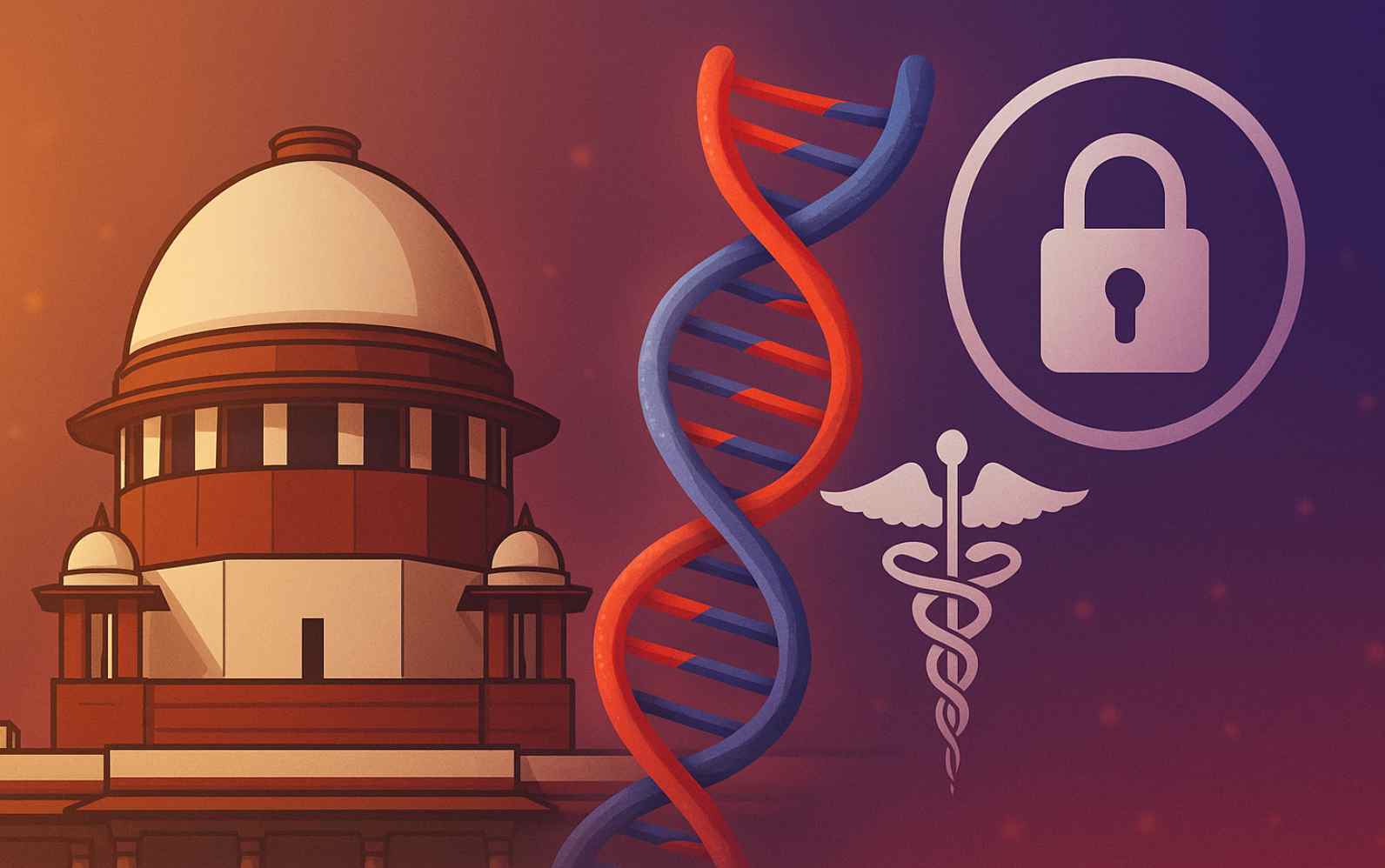
When the law shields family sanctity, science must not be weaponised. The Supreme Court has made this clear while ruling that ordering a DNA Test without nexus to an offence is unwarranted and violative of the Right to Privacy.
The ruling, in R. Rajendran vs. Kamar Nisha & Ors., reinforces that scientific tools cannot replace legal presumptions of legitimacy safeguarded under Section 112 of the Indian Evidence Act.
Court’s Core Observation
A Bench of Justice Prashant Kumar Mishra and Justice Vipul M Pancholi held that a child born during a valid marriage enjoys a “conclusive presumption of legitimacy”, which cannot be unsettled by mere suspicion or allegations of an affair.
The Court underscored that DNA profiling cannot be ordered as a matter of routine, as it directly affects the privacy, dignity, and legitimacy of the individuals involved.
Quoting the Bench:
“Section 112 embodies a legislative policy of profound significance. It stands as a bulwark against casual illegitimisation of children born within wedlock. The presumption is a substantive safeguard, not a procedural formality.”
Background of the Case
The dispute arose when the respondent, claiming an extramarital relationship with a doctor, alleged that her child was fathered by him. Following her televised statements, an FIR was filed under Sections 417 and 420 of the IPC and the Tamil Nadu Women Harassment Act.
During investigation, the police sought a DNA Test of the appellant, respondent, and the child.
When the doctor refused, the Madras High Court (Madurai Bench) ordered him to undergo DNA profiling. This direction, upheld by a Division Bench, reached the Supreme Court on appeal.
Supreme Court’s Detailed View
The apex court examined the matter through the lens of constitutional rights and evidentiary principles. Citing the precedent in Ivan Rathinam v. Milan Joseph, the Bench reiterated that two strict conditions must be satisfied before a DNA test is ordered:
- Insufficiency of existing evidence, and
- Positive balance of competing interests.
Finding neither condition met, the Court ruled that the presumption of legitimacy stood unrebutted. It noted that the husband’s name appeared on the child’s birth and school records, and there was no proof of “non-access” between the spouses at the relevant time.
Right to Privacy and Bodily Autonomy
Reaffirming privacy as a core constitutional value, the Court observed:
“Forcefully subjecting an individual to DNA testing constitutes a grave intrusion upon privacy and personal liberty. Such an encroachment is permissible only when it meets the tests of legality, legitimate state aim, and proportionality.”
Importantly, the Court clarified that a mother’s consent cannot waive the privacy rights of the alleged father or the child, particularly when the child has attained majority and is not a party to the proceedings.
Misuse of DNA Testing in Criminal Cases
Highlighting misuse of forensic tools, the Court noted that the paternity question had no direct nexus to the alleged offences of cheating and harassment. DNA testing, the Bench said, could not be justified merely to “corroborate gossip or suspicion.”
The Court disapproved of the High Court’s reliance on Sections 53 and 53A of the Code of Criminal Procedure, explaining that these provisions apply only where medical examination directly relates to the commission of an offence, not for speculative or collateral inquiries.
Adverse Inference Not Justified
Rejecting the respondent’s plea for drawing an adverse inference from the doctor’s refusal to undergo DNA testing, the Court relied on Aparna Ajinkya Firodia v. Ajinkya Arun Firodia (2023), clarifying that such inference arises only after a lawful and justified order for a DNA test, not before.
Court’s Final Word
In clear judicial prose, the Bench concluded:
“Scientific procedures, however advanced, cannot be used as instruments of speculation. They must be anchored in demonstrable relevance to the charge and justified by compelling investigative need.”
The Supreme Court thus set aside the Madras High Court’s order, holding that the DNA Test direction lacked nexus with the alleged offences, violated the Right to Privacy under Article 21, and endangered the legitimacy of the child.
Case Details
- Cause Title: R. Rajendran vs. Kamar Nisha & Ors.
- Bench: Justice Prashant Kumar Mishra and Justice Vipul M Pancholi
- For Appellant: Pulkit Tare, Sheikh F. Kalia, D. Kumanan, Ashwary Kathed, Suvendu Suvasis Dash (AOR)
- For Respondent: Ankur Prakash (AOR), M.P. Parthiban, Balaji Subramanian, A.A.G., Sabarish Subramanian, Danish Saifi, Akash Kundu
Follow The Legal QnA For More Updates…
R. Rajendran vs. Kamar Nisha & Ors.