












This case concerns the scope and interpretation of Section 23 of the Maintenance and Welfare of Parents and Senior Citizens Act, 2007, which empowers a Tribunal to declare a transfer of property void if it was made subject to a condition of providing basic amenities and physical needs to a senior citizen, and such condition is later violated.
The Supreme Court examined whether the High Court was justified in setting aside the Tribunal’s order canceling a gift deed executed by a senior citizen in favour of her son.
Facts
The appellant, Urmila Dixit, mother of the respondent, had purchased the property in question in 1968. On 07.09.2019, she executed a Gift Deed in favour of her son, which stated that the donee would maintain the donor and make provision for her needs. A vachan patra or promissory note was also allegedly signed on the same day, wherein the respondent undertook to take care of his mother for life, allowing her to revoke the gift if he failed to do so. The respondent later disputed this document as fabricated.
On 24.12.2020, the appellant filed an application under Sections 22 and 23 of the Act, alleging that her son had assaulted her and her husband in an attempt to coerce further property transfer and had stopped maintaining them. The Sub-Divisional Magistrate declared the Gift Deed null and void. The Collector affirmed this order in appeal.
A Single Judge of the Madhya Pradesh High Court upheld both orders, holding that the respondent had failed to serve his senior citizen parents. However, a Division Bench set aside these orders, reasoning that the Gift Deed contained no explicit maintenance clause, and therefore Section 23 could not be invoked. This decision led to the appeal before the Supreme Court.
Issue Involved
Whether the High Court was correct in setting aside the Tribunal’s order granting relief under Section 23 of the 2007 Act to the appellant?
Observations
The Supreme Court emphasized that the Senior Citizens Act is a beneficial legislation aimed at protecting elderly persons who are increasingly neglected due to social changes. Beneficial statutes must be interpreted liberally to advance their objectives.
Key Findings:
- The purpose of the Act is to provide speedy, simple, and inexpensive remedies to ensure the welfare of senior citizens.
- Courts must apply a purposive interpretation that furthers the Act’s objectives.
- Section 23 applies when a transfer is made subject to a condition of maintenance and that condition is later violated.
- Both the Gift Deed and the promissory note reflected the respondent’s obligation to care for the appellant.
- These documents were executed simultaneously, showing clear intent that maintenance was a condition of the transfer.
- The appellant had demonstrated that the respondent failed to provide maintenance and that relations had completely broken down.
The Supreme Court held that the Division Bench erred by adopting a narrow and technical view of Section 23, contrary to the beneficial nature of the legislation.
Guidelines / Legal Principles Recognized
- Beneficial legislation must be interpreted liberally to give effect to its purpose.
- Section 23 is not a standalone technical provision; it must be read in light of the Act’s broader goal of protecting senior citizens.
- The Tribunal may order eviction or restoration of possession where necessary to safeguard the senior citizen.
- When a transfer involves any undertaking of maintenance, Section 23 can be invoked if that obligation is violated.
- Strict or literal interpretation that undermines statutory protection is inappropriate.
Verdict
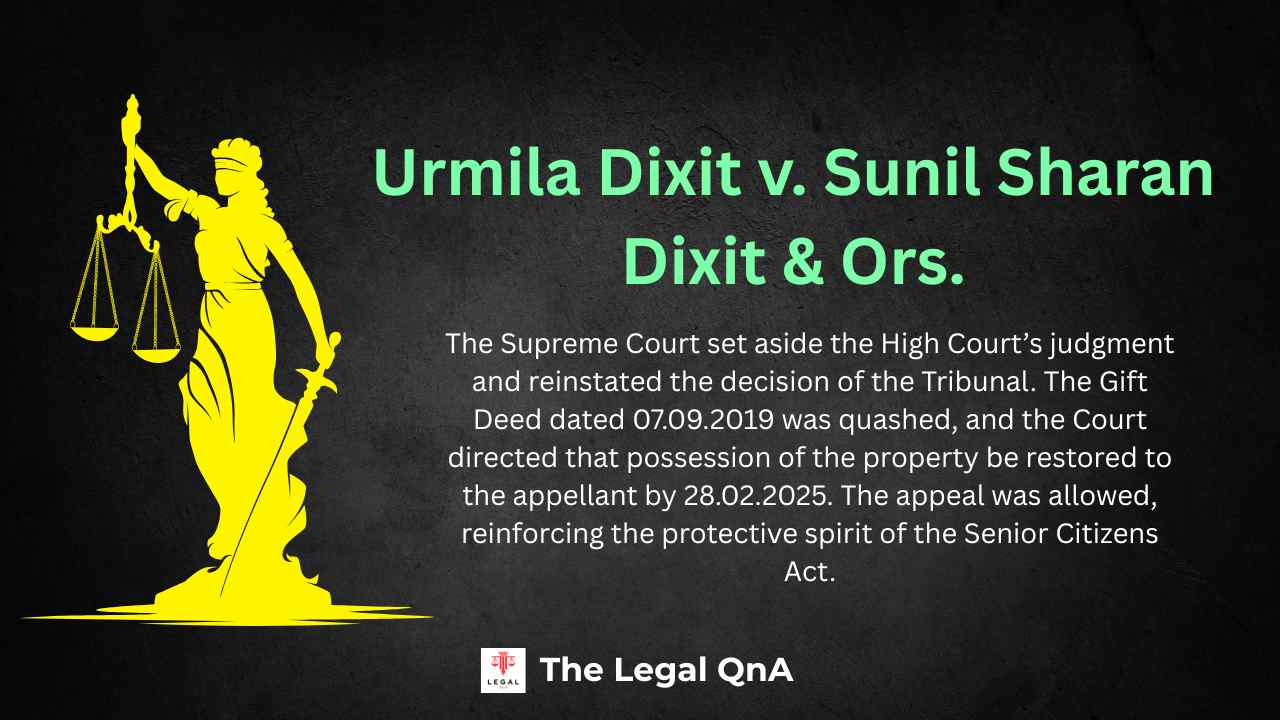
The Supreme Court set aside the High Court’s judgment and reinstated the decision of the Tribunal. The Gift Deed dated 07.09.2019 was quashed, and the Court directed that possession of the property be restored to the appellant by 28.02.2025. The appeal was allowed, reinforcing the protective spirit of the Senior Citizens Act.
Notes
Section 23: Transfer of Property to be Void in Certain Circumstances
A transfer of property by a senior citizen, subject to the condition that the transferee will provide basic amenities and physical needs, becomes void at the option of the transferor if the transferee fails to fulfill such conditions. The Tribunal may also enforce maintenance rights against gratuitous transferees.
Follow The Legal QnA For More Updates…