














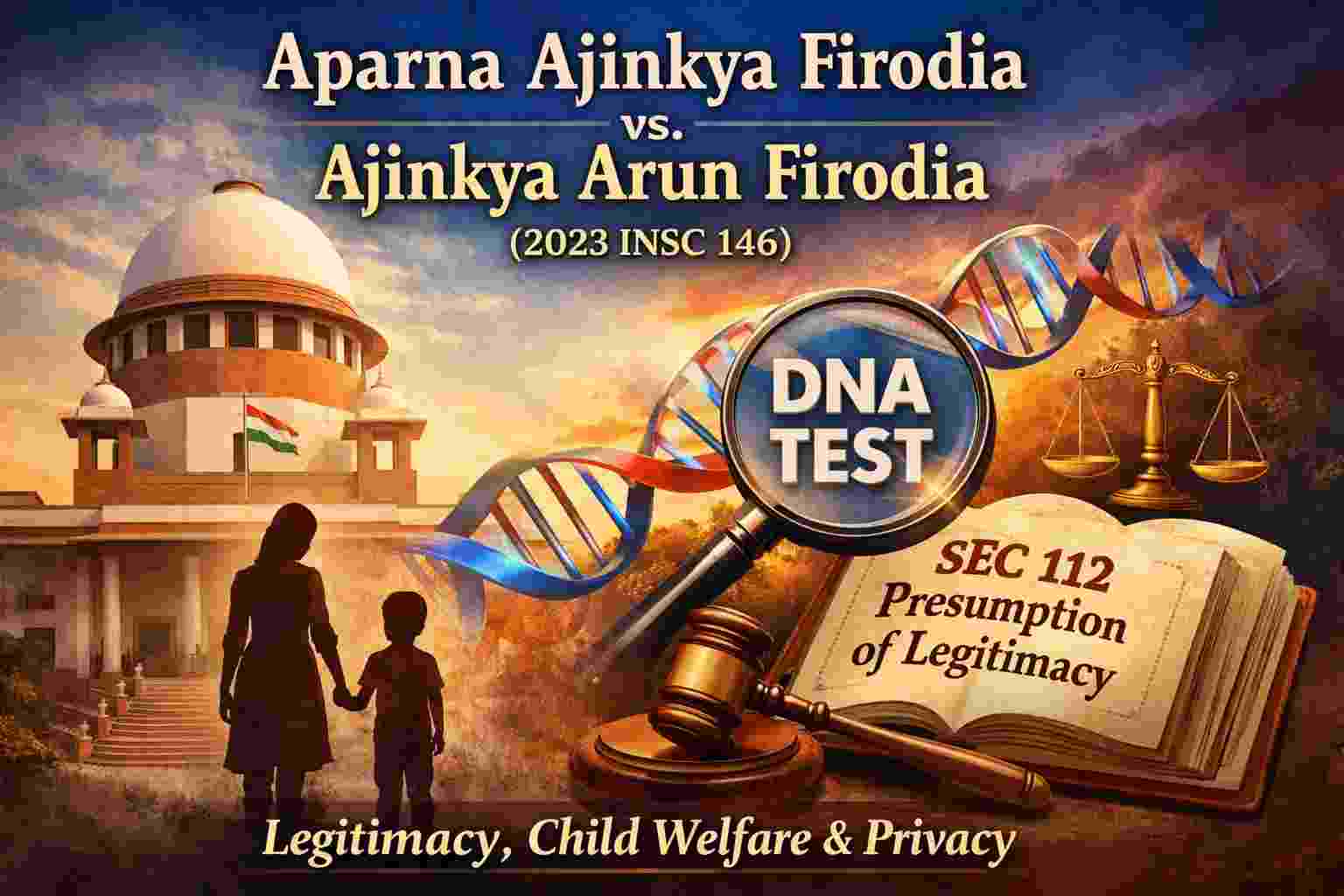
Presumption of Legitimacy, DNA Testing, and the Best Interests of the Child
The decision of the Supreme Court of India in Aparna Ajinkya Firodia v. Ajinkya Arun Firodia (2023 INSC 146) is a landmark ruling that revisits the delicate intersection between matrimonial disputes, modern scientific evidence, and the long-standing legal presumption of legitimacy under Indian law.
The judgment provides authoritative guidance on when courts may direct DNA testing of a child, the limits of such directions, and the paramount importance of a child’s dignity, privacy, and best interests.
Factual Background
The appellant-wife, Aparna Ajinkya Firodia, and the respondent-husband, Ajinkya Arun Firodia, were married in 2005. Two sons were born during the subsistence of their marriage, the younger child (“Master X”) being born in 2013.
In 2017, the husband instituted divorce proceedings alleging cruelty and adultery. During the pendency of these proceedings, he filed an application before the Family Court, Pune, seeking a direction to subject the younger child to a DNA test to establish that the child was not biologically his, asserting that the child was born out of the wife’s alleged adulterous relationship.
The Family Court allowed the application and further held that if the wife refused to comply, an adverse inference under Section 114(h) of the Indian Evidence Act, 1872 could be drawn against her. The Bombay High Court upheld this order. Aggrieved, the wife approached the Supreme Court.
Issues Before the Supreme Court
The Supreme Court framed the controversy around three core questions:
- Whether courts below were justified in directing DNA testing of a child born during a valid marriage, in light of Section 112 of the Evidence Act.
- Whether the refusal by the mother to subject the child to DNA testing could justify drawing an adverse inference of adultery under Section 114(h).
- How competing interests—truth-finding, privacy, legitimacy, and child welfare—ought to be balanced.
Section 112 and the Presumption of Legitimacy
Section 112 of the Indian Evidence Act embodies a rule of public policy: a child born during the continuance of a valid marriage is conclusively presumed to be the legitimate child of the husband, unless non-access between spouses at the relevant time is proved by strong and cogent evidence.
The Court reiterated that:
- “Access” refers to the existence of opportunity for sexual relations, not necessarily proof of actual cohabitation.
- Mere allegations of adultery do not rebut the presumption.
- Even scientifically accurate DNA evidence cannot, by itself, displace the statutory presumption unless non-access is first established.
This presumption, the Court emphasized, exists to protect children from the stigma of illegitimacy and to preserve social stability.
DNA Testing and Judicial Restraint
While acknowledging advancements in DNA profiling, the Court cautioned against treating such tests as routine tools in matrimonial litigation.
Drawing from precedents such as Goutam Kundu, Bhabani Prasad Jena, and Dipanwita Roy, the Court clarified that:
- DNA tests must not be ordered mechanically or on a “mere asking”.
- They are permissible only in exceptional cases where there is a strong prima facie case of non-access and where no other evidence can resolve the controversy.
- Courts must assess whether ordering such a test would unnecessarily jeopardize the child’s legitimacy, privacy, and psychological well-being.
In the present case, the husband had not pleaded non-access, and he himself admitted continuous cohabitation during the relevant period. Consequently, the foundational requirement to dislodge Section 112 was absent.
Adverse Inference Under Section 114(h): Limits Clarified
The Supreme Court decisively rejected the approach adopted by the Family Court and the High Court in threatening adverse inference for refusal to undergo DNA testing.
It held that:
- The presumption under Section 114(h) is discretionary, not mandatory.
- Refusal to subject a child to DNA testing cannot automatically translate into proof of adultery.
- Paternity of a child and allegations of adultery, though factually linked in some cases, are legally distinct issues.
Applying an adverse inference in such circumstances would indirectly undermine the conclusive presumption under Section 112, something impermissible in law.
Child’s Rights, Privacy, and International Norms
A significant aspect of the judgment is its child-centric approach.
The Court drew upon constitutional values and the UN Convention on the Rights of the Child, emphasizing:
- A child’s right to privacy, identity, and bodily integrity.
- The psychological trauma and social stigma that may follow from questioning legitimacy.
- The principle that children must not become “collateral damage” in matrimonial battles.
The Court underlined that the “best interests of the child” must be the primary consideration, and that forensic testing of children should not be used to advance a spouse’s litigation strategy.
Final Decision
The Supreme Court allowed the appeal, set aside the orders of the Family Court and the High Court, and held that:
- No DNA test of the minor child could be directed in the facts of the case.
- No adverse inference could be drawn against the wife for refusing such a test.
- The presumption of legitimacy under Section 112 remained intact.
Significance of the Judgment
This ruling reinforces several critical principles in Indian family law:
- Primacy of legitimacy: Section 112 continues to be a strong shield protecting children.
- Judicial caution with science: DNA evidence, though powerful, cannot override statutory presumptions without foundational facts.
- Child-centric justice: Courts must foreground the dignity, privacy, and welfare of children over adversarial interests of spouses.
By drawing clear boundaries on the use of DNA testing in matrimonial disputes, the Supreme Court has ensured that truth-seeking does not come at the cost of a child’s identity and emotional security.
Conclusion
In Aparna Ajinkya Firodia v. Ajinkya Arun Firodia (2023 INSC 146), the Supreme Court of India held that a child born during a valid marriage enjoys a strong legal presumption of legitimacy under Section 112 of the Indian Evidence Act.
The Court ruled that DNA tests cannot be ordered routinely in matrimonial disputes, especially without proof of non-access between spouses.
Refusing a DNA test cannot automatically lead to adverse inference of adultery. Emphasising child welfare, privacy, and dignity, the Court protected children from being used as tools in marital conflicts.
Follow The Legal QnA For More Updates…