










Key Takeaways
- The child’s best interests must always come first.
- States must provide protection and care to ensure a child’s well-being.
- Parents and legal guardians have recognized roles in supporting the child.
- Childcare institutions must meet safety, health, and supervision standards.
Article 12 of the UN Convention on the Rights of the Child (UNCRC) is one of the most powerful and transformative legal principles in international child rights law. It recognizes that children are not passive recipients of adult decisions.
They are rights holders with the legal entitlement to be heard and to participate in decisions that affect them.
Core Legal Principle of Article 12
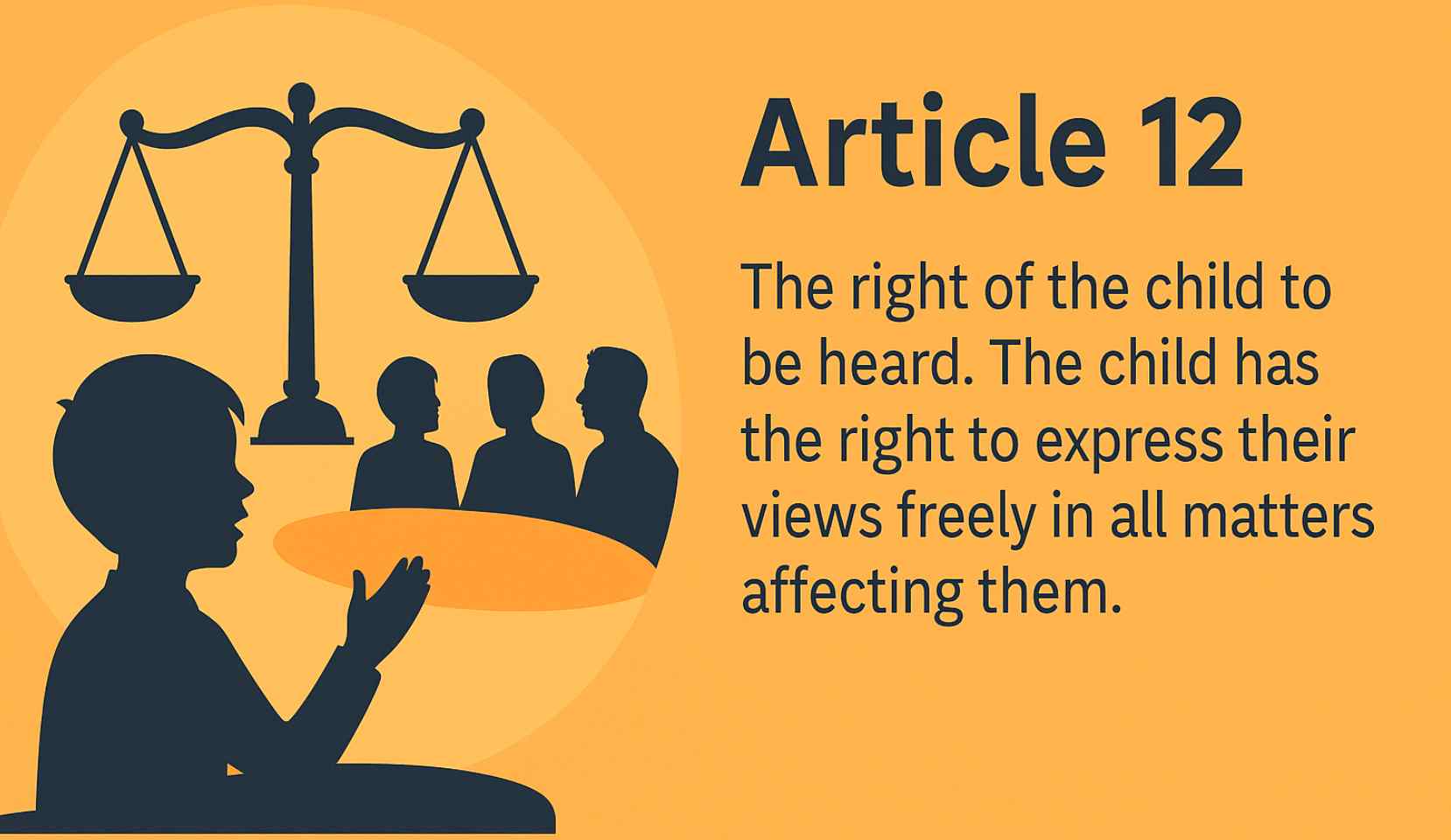
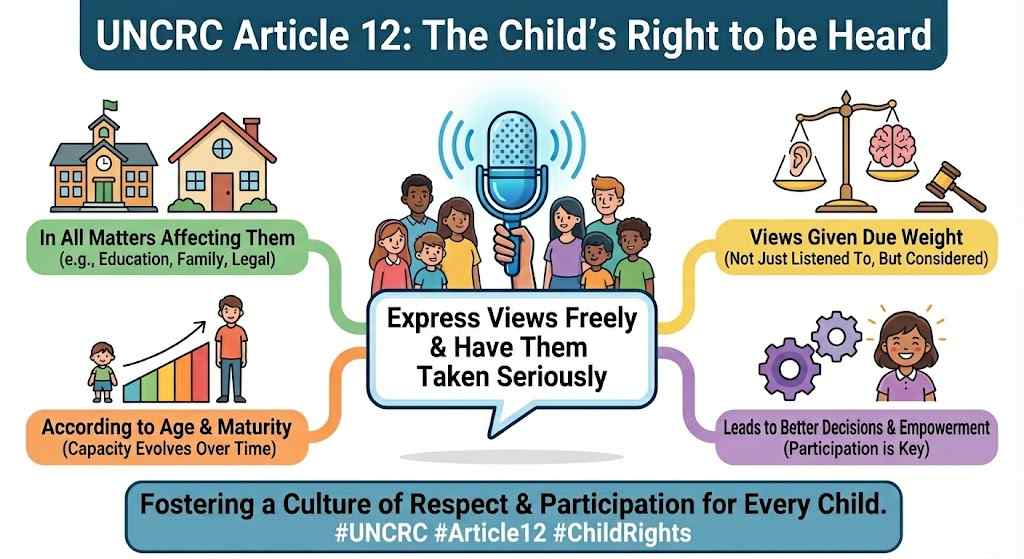
Article 12 affirms that every child who is capable of forming their own views has the right to express those views freely in all matters affecting them. The child’s opinions must be given due weight, taking into account their age and maturity.
This provision is not symbolic. It is binding on all states that have ratified the UNCRC. It requires procedural mechanisms and practical measures that guarantee meaningful participation of children in legal, administrative, and social contexts.
Participation as a Substantive Right
Article 12 establishes participation rights. This means participation is not optional charity from adults. It is a legal obligation. States must respect, protect, and fulfill the right to be heard.
What counts as “matters affecting the child”
This term is interpreted broadly. It includes:
- Family decisions such as custody, residence, schooling, or medical care
- Administrative decisions such as immigration and asylum procedures
- Judicial settings such as child protection, criminal justice or divorce cases
- Policy and institutional settings such as education systems, juvenile facilities and health care
The crucial test is whether the outcome influences the child’s life. If yes, Article 12 applies.
Due Weight to the Child’s View
One of the most misunderstood parts of Article 12 is the phrase “due weight”. It does not mean that adults must always follow what the child wants. It means that opinions must be evaluated respectfully and transparently.
Age vs Maturity
The Convention links weight to the evolving capacities of the child. A 6 year old may express preferences about daily routines or comfort in a parent’s home. A 15 year old may be able to articulate complex arguments about school choices or safety conditions.
Courts and decision makers must look beyond age alone and examine maturity, understanding of consequences, consistency of views and the context in which the opinion is given.
Article 12 and the Child’s Right to Information
Meaningful participation is impossible without access to information. States must ensure that children understand the issues they are consulted on.
Information must be age-appropriate, accessible and honest. Children must be free to ask questions and receive answers without fear of punishment or ridicule.
Expression Without Pressure
Article 12 prohibits coercion. Children should not be manipulated, bribed, intimidated, or emotionally pressured into taking a position.
Consent must be free and voluntary. Adults who represent children must not distort or selectively report their opinions.
Legal Procedures and Representation
Article 12 is deeply tied to procedural justice. Children must be able to:
- Speak directly in hearings
- Express views through trained professionals
- Submit written or recorded statements
- Use representatives or advocates when direct participation is stressful or unsafe
Modern legal systems encourage child friendly procedures. These include special interview rooms, culturally sensitive interpreters, preparation sessions and communication methods adapted to disability. Justice must not be adult centric.
Distinction from Article 3
Article 3 of the UNCRC says that the best interests of the child must be a primary consideration. Article 12 complements this standard.
To determine a child’s best interests, decision makers need the child’s own perspective. Ignoring Article 12 while applying Article 3 results in paternalism and violates human dignity.
What does Article 3 of the UN Convention on the Rights of the Child (UNCRC) state?
- In all actions concerning children, whether undertaken by public or private social welfare institutions, courts of law, administrative authorities or legislative bodies, the best interests of the child shall be a primary consideration.
- States Parties undertake to ensure the child such protection and care as is necessary for his or her well-being, taking into account the rights and duties of his or her parents, legal guardians, or other individuals legally responsible for him or her, and, to this end, shall take all appropriate legislative and administrative measures.
- States Parties shall ensure that the institutions, services and facilities responsible for the care or protection of children shall conform with the standards established by competent authorities, particularly in the areas of safety, health, in the number and suitability of their staff, as well as competent supervision.
Implementation Challenges
While most countries have ratified the UNCRC, Article 12 is often weakly implemented. Obstacles include:
- Cultural beliefs that children must obey adults
- Lack of training for judges or social workers
- Fear of exposing children to stressful processes
- Insufficient legal pathways for participation
- Token consultation that is not taken seriously
Meaningful application requires legal reforms, capacity building and institutional accountability.
Related Articles

Why Article 12 Matters
Children learn citizenship through participation. They develop confidence, decision making skills and a sense of responsibility. More importantly, Article 12 prevents harm. When children are able to speak, abuse, discrimination and neglect are more likely to be reported and stopped.
Article 12 is therefore not only about democratic values. It is about safety, development and respect for human dignity.
Concluding Analysis
Article 12 of the UNCRC marks a major shift. Instead of adults always speaking on behalf of children, it recognizes that children have the right to speak for themselves. Their voices must be heard, taken seriously, and protected through fair procedures and supportive systems.
This means governments, professionals, and communities must see children not just as people who need care, but as individuals with their own rights, opinions, and agency. Truly respecting Article 12 is a core requirement for any legal system that claims to protect human rights.
Follow The Legal QnA For More Updates…
Article Sources ▾
The Legal QnA maintains the highest standards of accuracy and integrity in its legal content. Our writers and contributors rely on primary sources such as international treaties, official legal commentaries, institutional guidelines, and jurisprudence from relevant courts or treaty bodies. We also incorporate insights from recognized academic publications and expert analyses to ensure trustworthy interpretation. Every article is verified and reviewed to meet established standards of authenticity, clarity, and legal reliability.
Refer to the official sources below for in-depth reading:
- United Nations Office of the High Commissioner for Human Rights (OHCHR): Convention on the Rights of the Child — Full Text
- United Nations Committee on the Rights of the Child: General Comments and Observations (including General Comment No. 12 on the Right of the Child to be Heard)
- UN Committee on the Rights of the Child: General Comment No. 12 (CRC/C/GC/12) — The Right of the Child to Be Heard
- UNICEF Innocenti: Research publications and child participation insights
- UNICEF: UNCRC Child-Friendly Convention Text