











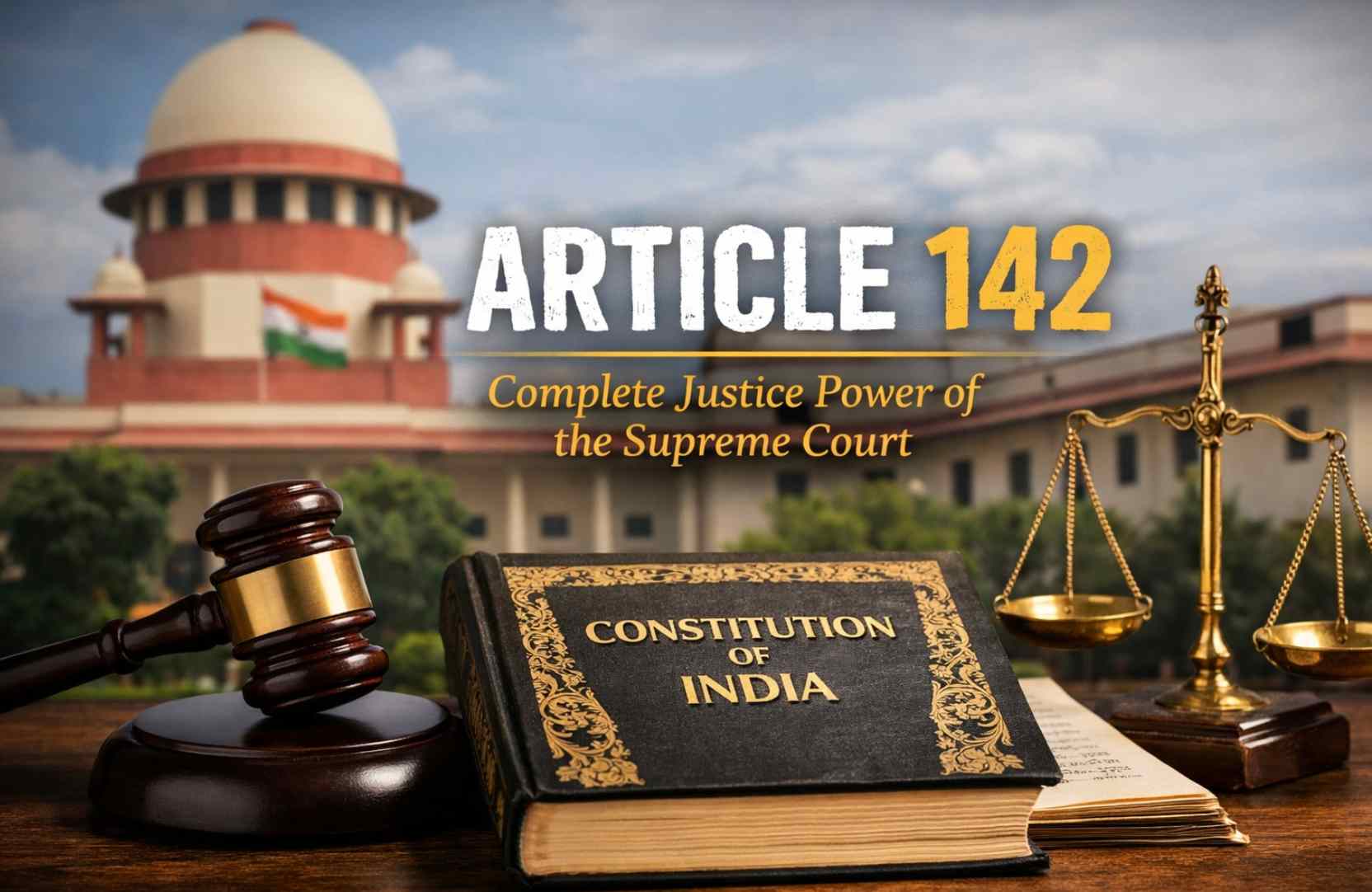
Article 142 of the Constitution of India empowers the Supreme Court to pass any order or decree necessary to ensure complete justice in a case, allowing it to go beyond procedural limitations when existing laws fail to deliver fair outcomes.
The Supreme Court’s Power to Deliver Complete Justice
The Constitution of India is not a cold legal manuscript confined to courtrooms and textbooks.
It is a living, breathing charter that governs the everyday lives of over a billion people. It seeks not only to regulate power but to humanize it.
Within this vast constitutional framework lies Article 142, a provision that embodies the spirit of justice beyond technical legality.
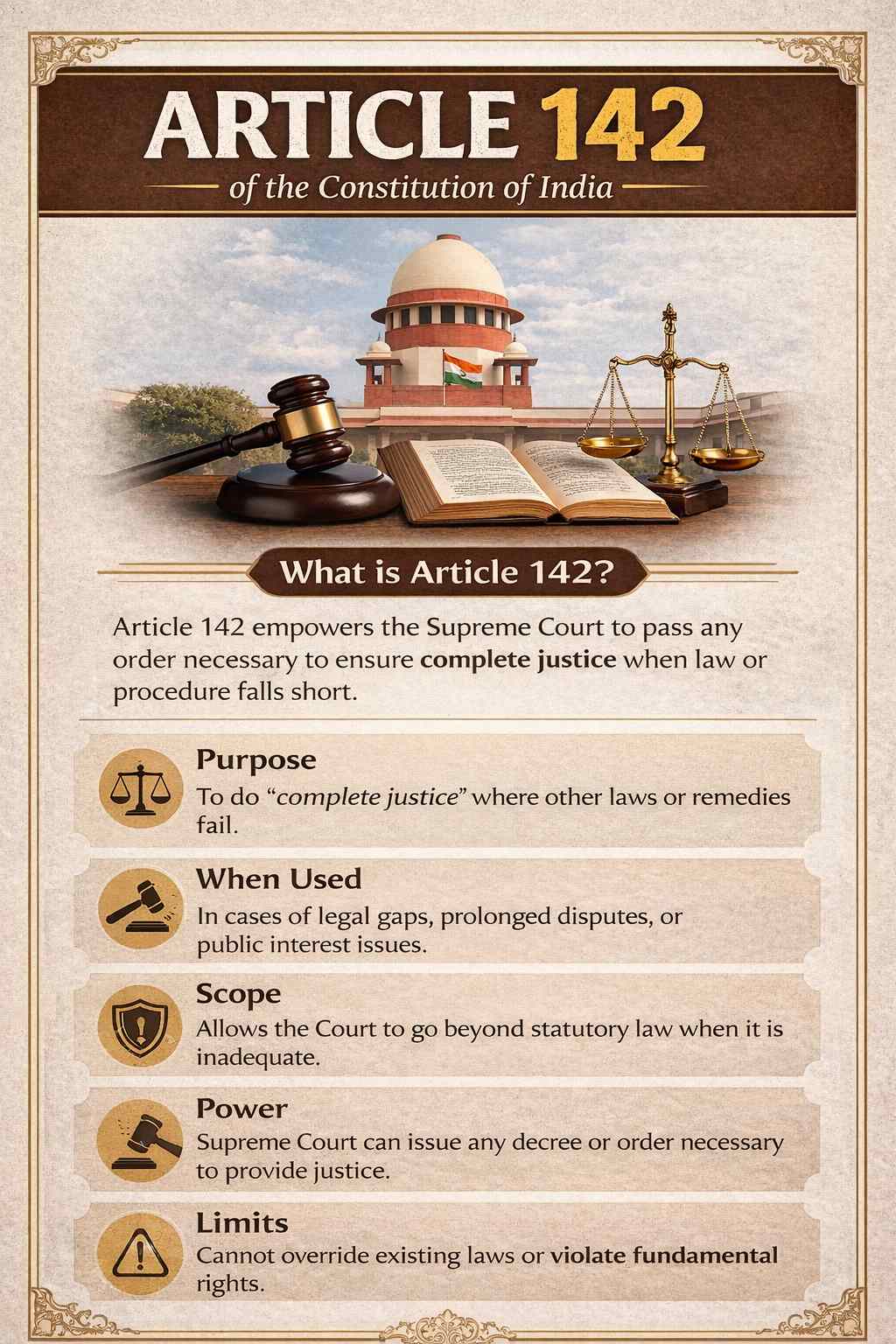
Article 142 empowers the Supreme Court of India to pass any decree or order necessary to do complete justice in a matter before it.
This single sentence carries extraordinary constitutional weight.
It allows the highest court of the country to step in when rigid application of law fails to address human suffering, social imbalance, or institutional failure.
Over the decades, Article 142 has emerged as one of the most discussed constitutional provisions.
It has been praised as a powerful instrument of justice and criticized as a source of judicial excess.
It has resolved long-standing disputes, filled legislative gaps, protected fundamental rights, and at times unsettled traditional ideas of separation of powers.
What is Article 142 of the Constitution of India
Article 142 finds place in Part V, Chapter IV of the Constitution, which deals with the Union Judiciary.
It directly relates to the functioning and authority of the Supreme Court.
The text of Article 142 states that the Supreme Court may pass any decree or make any order necessary for doing complete justice in any cause or matter pending before it.
The second clause enables the Court to ensure the attendance of persons, the discovery of documents, or the investigation and punishment of contempt.
On a plain reading, Article 142 grants the Supreme Court a unique constitutional authority.
Unlike ordinary judicial powers which are constrained by statutes and procedures, Article 142 allows the Court to go beyond limitations when justice so demands.
This provision does not operate in isolation.
It works in harmony with Articles 32, 136, 141, and 144, all of which reinforce the Supreme Court’s role as the final interpreter and protector of the Constitution.
The Meaning and Scope of “Complete Justice”
The expression “complete justice” is intentionally broad. The Constitution does not define it, nor does it attempt to limit its meaning.
This open-ended phrasing is one of the most significant aspects of Article 142.
Complete justice is not the same as legal correctness. A judgment may be legally sound yet unjust in its consequences. Complete justice addresses this gap.
It looks beyond technical compliance and focuses on outcomes that are fair, equitable, and humane.
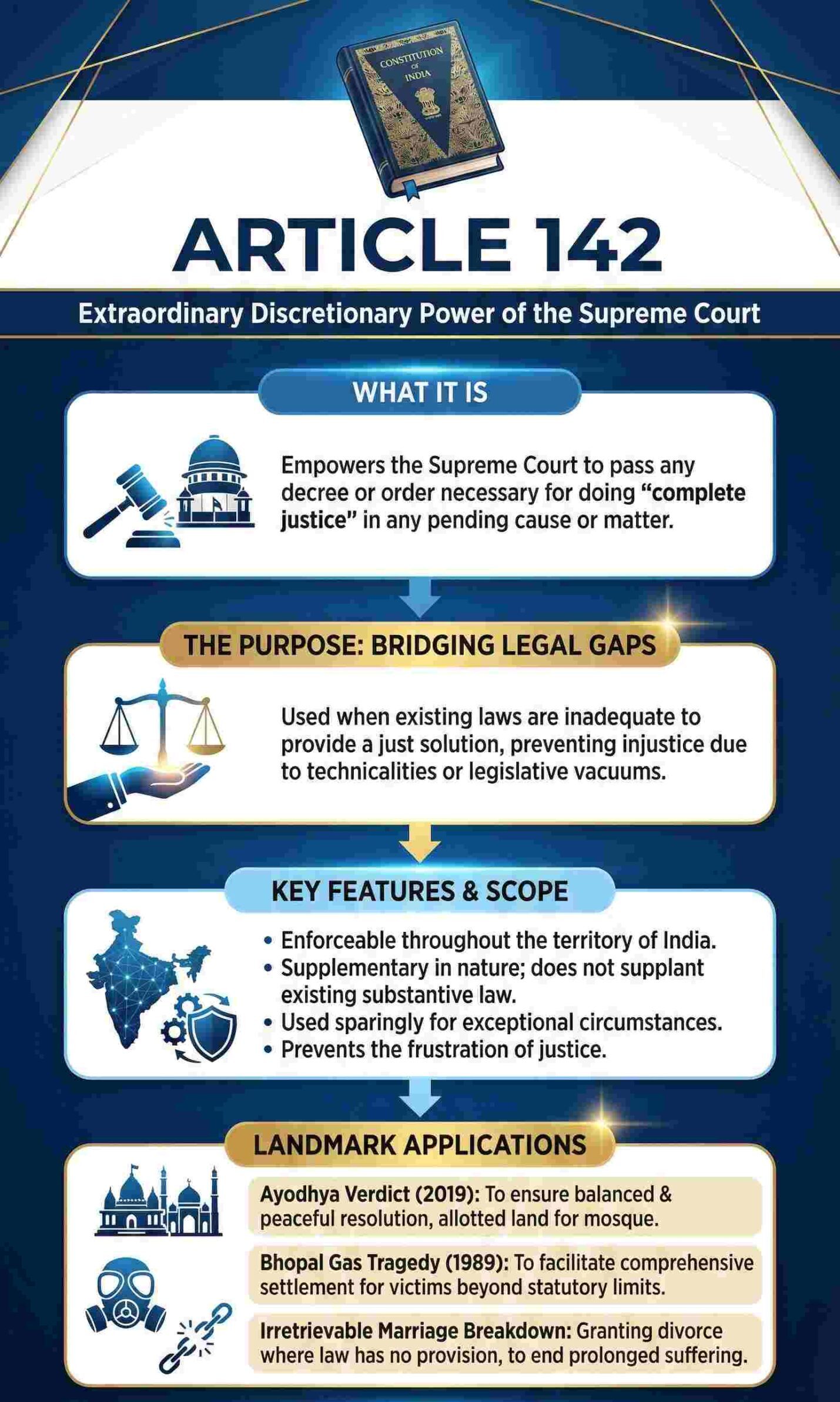
In Indian society, disputes often involve deep social, emotional, and economic dimensions. Strict adherence to procedural law may prolong suffering or deny meaningful relief.
Article 142 enables the Supreme Court to consider the totality of circumstances and fashion remedies that genuinely resolve disputes.
The Court has repeatedly clarified that complete justice depends on facts of each case.
What constitutes complete justice in a matrimonial dispute may differ from that in a constitutional challenge or an environmental case.
This flexibility is both the strength and responsibility of Article 142.
Historical Background
To appreciate Article 142, one must look at the historical context in which the Constitution was drafted.
India emerged from colonial rule with widespread poverty, inequality, illiteracy, and social divisions. The framers were acutely conscious that law alone could not address all injustices.
During the Constituent Assembly debates, there was a clear understanding that the judiciary must be empowered to protect citizens not only from unlawful state action but also from systemic failures.
The Supreme Court was envisioned as more than a passive interpreter of laws.
Dr B R Ambedkar and other framers believed that constitutional courts must have the authority to respond to unforeseen situations. Article 142 reflects this trust.
It was designed as a constitutional safeguard against injustice arising from legal gaps or rigid procedures.
The provision acknowledges a simple truth. No legislature, however wise, can anticipate every future contingency.
Article 142 ensures that justice does not wait for legislative correction when urgent intervention is required.
The Supreme Court as a Constitutional Guardian
Article 142 reinforces the Supreme Court’s position as the guardian of the Constitution. It recognizes that constitutional adjudication is not always a mechanical exercise.
Judges are often required to balance competing rights, interests, and values.
The Supreme Court, under Article 142, is empowered to do what ordinary courts cannot. It can mould reliefs, issue directions, and create temporary frameworks to address complex issues.
This role becomes particularly important in public interest litigation. Many PIL cases involve vulnerable communities, environmental degradation, administrative apathy, or human rights violations. Traditional remedies may prove ineffective in such scenarios.
Article 142 allows the Court to respond creatively and decisively. It ensures that justice is not reduced to academic reasoning but translates into tangible change.
Nature of Powers Under Article 142
The powers under Article 142 are extraordinary in nature. They are discretionary and equitable rather than rigid and formulaic. However, extraordinary does not mean arbitrary.
The Supreme Court has consistently held that Article 142 must be exercised with caution.
It is not meant to replace statutory law or override constitutional provisions. Instead, it supplements existing legal frameworks.
The power under Article 142 is case specific. Orders passed under this provision are tailored to the peculiar facts of each matter.
They do not automatically become binding precedents in the way judgments under Article 141 do.
This ensures that Article 142 remains a tool of justice rather than a source of unchecked authority.
Landmark Judgments Shaped by Article 142
The Bhopal Gas Tragedy Case
The Bhopal gas disaster remains one of the darkest chapters in India’s industrial history. Thousands lost their lives, and countless others suffered permanent health damage.
Faced with an unprecedented humanitarian crisis, the Supreme Court invoked Article 142 to approve a settlement between Union Carbide and the Government of India.
The objective was to provide immediate relief to victims rather than prolong litigation.
While the decision faced criticism, it highlighted the Court’s attempt to balance legal complexities with urgent human needs.
Article 142 enabled the Court to act swiftly in a situation where traditional remedies would have taken decades.
Vishaka v State of Rajasthan
Before the enactment of legislation on workplace sexual harassment, there was no effective legal mechanism to address such misconduct.
In the Vishaka case, the Supreme Court used Article 142 to lay down binding guidelines to protect working women.
These guidelines operated as law until Parliament enacted appropriate legislation. This judgment is often cited as a classic example of judicial creativity guided by constitutional morality.
Article 142 played a central role in ensuring gender justice and dignity in the workplace.
Ayodhya Ram Janmabhoomi Case
The Ayodhya dispute involved deep religious, historical, and political sensitivities. While deciding the title suit, the Supreme Court also addressed the need for social harmony.
Invoking Article 142, the Court directed allotment of alternative land for construction of a mosque. This direction went beyond the immediate dispute and aimed at restorative justice.
The use of Article 142 in this case demonstrated the Court’s commitment to constitutional balance and reconciliation.
Article 142 and Fundamental Rights
When fundamental rights are violated, the problem is often not proving the violation. It is what comes next.
A declaration that a right has been breached does not always repair the damage caused.
In many cases, the usual remedies offered by law feel inadequate, almost symbolic, when weighed against the harm suffered.
This is where Article 142 has quietly shaped rights jurisprudence.
In cases of custodial violence or illegal detention, the Court has been faced with situations where years have already been lost, lives have been altered, and trust in the system has been broken.
Simply awarding compensation, while necessary, does not address how or why the violation occurred. Using Article 142, the Court has been able to go further.
It has ordered institutional reforms, issued binding directions, and demanded accountability beyond individual cases.
Environmental violations present a similar challenge. Damage to air, water, or land cannot always be undone with money.
The Court has recognised that treating such harm as a compensable wrong misses the larger issue.
Article 142 has allowed the Court to intervene in ways that prevent repetition, by regulating activity, imposing safeguards, and sometimes halting harmful practices altogether.
This approach has been especially important in shaping the meaning of the right to life under Article 21.
Over time, the Court has moved away from a narrow understanding of survival to a broader idea of living with dignity.
Health, livelihood, clean surroundings, and personal security have all come to be seen as part of that right.
Article 142 has ensured that these interpretations do not remain abstract principles.
It has given the Court the ability to translate constitutional language into real, enforceable outcomes when ordinary remedies fall short.
Article 142 in Matrimonial and Family Disputes
One of the most frequent uses of Article 142 is seen in matrimonial cases. Indian family law statutes often contain rigid procedural requirements that may prolong suffering.
In cases where marriages have irretrievably broken down, the Supreme Court has invoked Article 142 to dissolve the marriage even when statutory grounds were not strictly met.
The Court has recognized that forcing parties to remain in a dead marriage serves no purpose and only perpetuates emotional distress.
Article 142 has also been used to settle issues of maintenance, alimony, and child custody in a holistic manner.
These interventions reflect judicial empathy and practical wisdom.
Article 142 and the Criminal Justice System
Criminal cases are where the Court has been the most cautious with Article 142, and for good reason. Criminal law is not just about the individual before the court.
It speaks for society as a whole. Every decision sends a signal about what the system tolerates and what it condemns.
The Supreme Court has been conscious of this weight, and it shows in how sparingly this power is used in criminal matters.
That said, there are situations where continuing a criminal case serves no real purpose.
Sometimes proceedings drag on for years despite the dispute having lost all substance.
Sometimes cases are used as tools for harassment, revenge, or pressure rather than genuine prosecution.
In such exceptional situations, the Court has stepped in under Article 142 to put an end to proceedings that had become an abuse of the process itself.
The idea is not to excuse wrongdoing, but to prevent the law from being misused as a weapon.
Article 142 has also been used to address the position of victims, who are often forgotten once the focus shifts to the accused and the State.
In certain cases, the Court has directed compensation, medical support, or rehabilitation measures that go beyond what the criminal procedure normally provides.
These directions recognise that justice is incomplete if the harm suffered by victims is ignored.
At the same time, the Court has drawn a firm line. Serious offences that affect public order, involve violence, corruption, or moral wrongdoing are not treated lightly.
The Supreme Court has repeatedly made it clear that Article 142 cannot be used to settle or compromise crimes that have wider social consequences.
Environmental Protection and Article 142
Environmental cases are where Article 142 has quietly done some of its most important work.
Not in dramatic language, but in situations where rivers were dying, forests were disappearing, and nobody in authority seemed willing to take responsibility.
The laws were already there. Pollution control statutes, forest acts, clearance rules. On paper, everything existed. On the ground, very little changed.
What repeatedly came before the Supreme Court was not the absence of law, but the absence of action.
Files moved slowly, regulators looked the other way, and industries carried on as usual. In those moments, the Court was left with a choice.
Either limit itself to recording violations and sending matters back to the same agencies that had failed, or step in and make its orders actually mean something.
Article 142 made the second option possible.
Using it, the Court has ordered industries to shut down or relocate, directed clean-up of polluted rivers, restricted mining and construction in sensitive areas, and imposed timelines where none existed before.
These were not policy experiments. They were responses to visible damage and long delay.
What stands out is that many of these directions were not meant to punish, but to prevent further harm.
Environmental damage does not wait for administrative convenience. Once a forest is cut or a water source poisoned, the loss is permanent.
Article 142 allowed the Court to act with that urgency in mind.
There is also a deeper idea running through these cases. The Court has repeatedly treated the environment not as property, but as a shared trust.
Decisions under Article 142 reflect an understanding that today’s development cannot come at the cost of tomorrow’s survival.
Relationship with Separation of Powers
Arguments about separation of powers surface almost every time Article 142 is used. The concern is familiar. That the Court is stepping into territory meant for the legislature or the executive.
On the surface, the concern sounds reasonable. In a democracy, no institution is supposed to do everything.
But the Indian Constitution was never built on a rigid idea that each organ would operate in isolation. It assumes overlap. It assumes friction.
Most importantly, it assumes that one institution may have to step in when another stops functioning as it should. That is the context in which Article 142 exists.
What the Court does under Article 142 is often mistaken for lawmaking. In reality, these directions are usually temporary, situation specific, and tied to a failure that already exists.
The Court does not set out to replace Parliament or run the administration. It responds to gaps, delays, and refusals to act that leave people without remedies.
There is also a pattern that is easy to miss. Many judicial directions given under Article 142 do not remain in place forever. They trigger responses.
Legislatures step in. Rules are framed. Policies are corrected. In that sense, Article 142 often acts as a push rather than a takeover.
If anything, these interventions expose weaknesses in governance rather than create them. They make it harder for institutions to ignore problems indefinitely.
Instead of weakening democracy, Article 142 has often forced it to function the way it was originally intended, with accountability and responsibility shared across all branches of power.
Limitations and Judicial Restraint
The Supreme Court has never treated Article 142 as a free pass to do whatever feels right in the moment.
In fact, some of the clearest warnings about its limits have come from the Court itself.
Judges have repeatedly acknowledged that a power this wide can lose its credibility if it is used casually or without reflection.
Over the years, the Court has drawn its own boundaries. One of the clearest is that Article 142 cannot be used to openly override statutory law.
If Parliament has spoken clearly on an issue, the Court has recognised that it cannot simply brush that aside in the name of equity.
The power is meant to fill gaps, not bulldoze existing frameworks.
The same caution applies to constitutional principles. Orders under Article 142 are expected to respect fundamental rights and the overall structure of the Constitution.
When the Court steps in, it is still bound by the values that define the legal system. That awareness has shaped how carefully this power is exercised.
What makes this restraint significant is that it is not imposed from outside. There is no checklist in the Constitution telling the Court when to stop.
The discipline comes from within the institution. That self control is what has allowed Article 142 to survive scrutiny and criticism over decades.
Without it, the provision would have become controversial very quickly. With it, the power remains exceptional rather than routine, and trusted rather than feared.
Criticism of Article 142
Despite its contributions, Article 142 is not without criticism. Some argue that it introduces subjectivity and uncertainty in law.
Others fear that excessive reliance on judicial discretion may undermine democratic processes.
These concerns merit consideration. However, they must be weighed against the realities of governance in a diverse society like India.
The answer lies not in curtailing Article 142 but in ensuring responsible exercise.
Conclusion
When you look at Article 142 closely, it does not feel like a power that was written to impress anyone.
It feels like something added because the framers knew the law would fail people sometimes.
Not because judges are careless, but because written rules can never cover every situation that life throws up.
There are cases where following the book gives an answer, but not a solution. Anyone who has watched litigation drag on for years knows this.
Article 142 exists for those moments. It gives the Supreme Court room to stop pretending that procedure alone equals justice.
The interesting part is not the power itself, but the trust behind it. The Constitution does not say exactly how this power should be used.
It simply assumes that the Court will know when to step in and when to stay back. That kind of silence is not accidental. It is confidence.
People worry about misuse, and that concern is fair. But the alternative would be a system where courts see injustice clearly and still say their hands are tied.
That would be far worse. Article 142 prevents that helplessness. It allows the Court to act when waiting for perfect legality would only make things worse.
Follow The Legal QnA For More Updates…
Article Sources
▾
The Legal QnA maintains the highest standards of accuracy and integrity in its legal content. Our writers and contributors rely on primary sources such as statutory laws, government notifications, regulatory circulars, and judicial precedents. We also incorporate insights from recognized legal commentaries, expert opinions, and academic publications where relevant. Every article is fact-checked and reviewed by qualified professionals to ensure it reflects current law and authoritative interpretation.
Refer to the official sources below for in-depth reading:
- Indian Kanoon: Article 142 – Enforcement of decrees and orders of Supreme Court.
- Constitution of India (Historical): Constituent Assembly Debates & Text of Article 142.
- Supreme Court Observer: Journal: ‘Complete Justice’ under Article 142 of the Constitution.
- IIM Ahmedabad: Empirical Study: Supreme Court’s Use of Inherent Power.
- IJRTI Research Paper: Academic Analysis of Article 142 (PDF).
- DD News (Govt of India): Article 142 – The Supreme Power or Judicial Overreach?
- India Today (Video): Explainer: Significance of Article 142 of the Indian Constitution.
- Government of India Repository: Official Document/Notification (PDF).
- India Code (Legislative Dept): The Constitution of India (Full Official Text).
- NLSIR (National Law School): Scholarly Review: Dimensions of Article 142.
