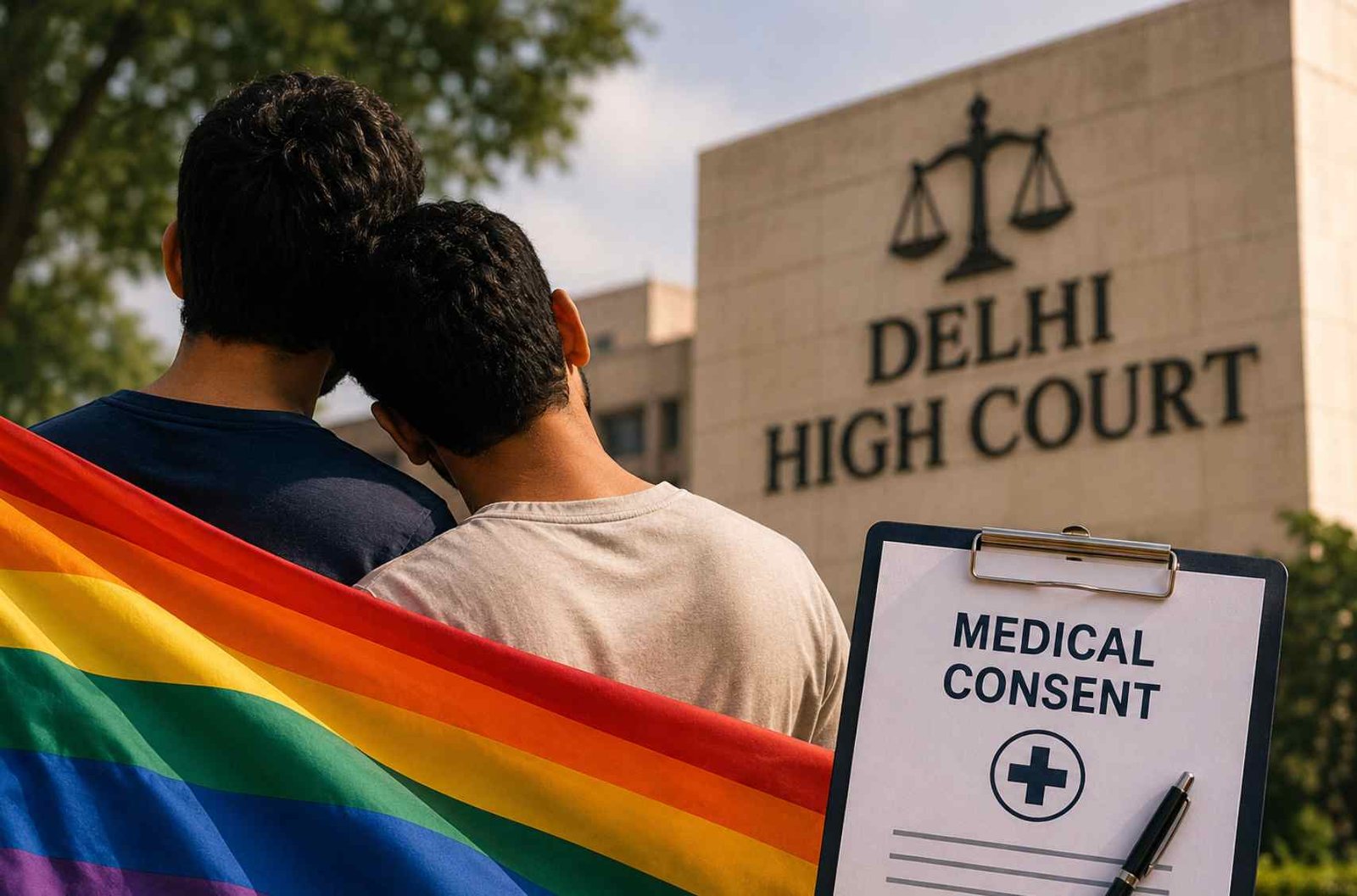
New Delhi | August 20, 2026: The Delhi High Court has questioned the legal basis for excluding same-sex partners from taking medical decisions for each other, observing that if the law permits a man and a woman to live together in a relationship, the position of same-sex partners also requires consideration.
The observation was made by Justice Swarana Kanta Sharma while hearing a petition filed by Arshiya Takkar, seeking recognition of a non-heterosexual partner as a patient’s medical representative during medical treatment and emergencies.
The Court was particularly concerned with the Central government’s failure to file its counter-affidavit despite the petition having been pending for more than a year.
Justice Sharma asked the Centre’s counsel:
“The law recognises a live-in relationship between a man and a woman. Why will it not allow a live-in relationship between a man and a man?”
The Court has now granted the Union Government one week’s time to file its response. The matter has been listed for further hearing on September 17, 2026, with the Court indicating that it intends to deal with the matter by September.
Plea seeks medical decision-making rights for queer partners
The petition raises a practical issue concerning the ability of queer partners to stand in for each other when medical decisions have to be taken.
Takkar has sought directions for framing appropriate guidelines requiring hospitals and medical practitioners to recognise a patient’s non-heterosexual partner as a medical representative and permit such partner access during medical treatment and emergencies.
As an alternative relief, the petitioner has sought a declaration that a medical power of attorney executed in advance by a patient in favour of their non-heterosexual partner should be sufficient to enable that partner to act as the patient’s medical representative.
The petition challenges the absence of an express mechanism for recognising such partners under the existing medical regulatory framework.
Challenge based on Articles 14, 15 and 21
The petitioner has argued that the existing framework creates a form of systemic exclusion because it does not adequately recognise non-heterosexual partners in medical decision-making.
The plea invokes Articles 14, 15 and 21 of the Constitution, contending that the exclusion has a discriminatory impact on queer couples and affects their right to dignity, autonomy and personal choice.
Reliance has also been placed on the Supreme Court’s jurisprudence concerning privacy, dignity, sexual orientation and the right of queer persons to form relationships.
The petition refers to the constitutional protection recognised in Navtej Singh Johar v. Union of India, particularly in relation to discrimination based on sexual orientation.
The petitioner’s case is essentially that recognition of personal autonomy cannot stop merely because the relationship is between persons of the same sex.
Saurabh Kirpal: Right to relationship must have meaningful content
Senior Advocate Saurabh Kirpal, appearing for the petitioner, submitted that the Supreme Court may not have recognised a constitutional right to same-sex marriage, but its jurisprudence does recognise the right of queer persons to form relationships.
According to the petitioner’s submissions, permitting queer persons to live together while denying their partners any meaningful role during medical emergencies would reduce the constitutional protection of relationships to an empty formality.
Kirpal relied upon the principles of privacy, dignity and autonomy under Article 21 and argued that a person should have the freedom to choose who will care for them and represent their interests when they are medically incapacitated.
Court raises concern over family rejection
During the hearing, Justice Sharma also took note of the social realities faced by queer persons whose relationships may not receive acceptance from their families.
The Court observed that persons who choose a path different from that followed by the majority may face social rejection and pointed out that there are cases where families refuse to accept their children’s relationships.
The concern assumes particular importance in medical emergencies, where a patient’s partner may be the person physically present and best placed to communicate the patient’s wishes, while family members may be unavailable or unwilling to participate.
Centre given one week to file counter-affidavit
The Court noted that notice had been issued to the concerned authorities in July 2025, but the Centre had still not filed its counter-affidavit.
Although the government’s counsel sought additional time on the ground that the counsel had recently been appointed and required instructions, the Court made it clear that the matter could not remain unanswered indefinitely.
The Court recorded that the counter-affidavit was necessary for adjudication of the issues and consequently granted the Centre one final week to place its stand on record.
The Court also asked the government counsel to advise the concerned departments to take a decision on the petition.
Justice Sharma indicated that the issue concerned safeguards in the medical context and observed that appropriate changes could potentially be considered without disturbing the broader legal framework.
What the Delhi HC has decided so far
Importantly, the Delhi High Court has not yet delivered a final judgment recognising same-sex live-in relationships for all purposes through this proceeding.
The present hearing concerns the petitioner’s demand for recognition of a queer partner as a medical representative and for a mechanism enabling such a partner to participate in medical decisions.
The Court’s observations are therefore significant judicial remarks during the hearing and should not be treated as a final declaration of law on same-sex marriage or the overall legal status of same-sex relationships in India.
The next substantive step is the Centre’s response, after which the Court is expected to consider the constitutional and regulatory questions raised by the petition.
Case Details
- Case Title: Arshiya Takkar v. Union of India & Ors.
- Court: High Court of Delhi
- Bench: Justice Swarana Kanta Sharma
- Petitioner: Arshiya Takkar
- Respondents: Union of India and concerned Central authorities, including the Ministry of Health and Family Welfare, Ministry of Social Justice and Empowerment, Ministry of Law and Justice and the National Medical Commission
- Petitioner’s Counsel: Senior Advocate Saurabh Kirpal, assisted by Senior Advocate Shyel Trehan and Advocates Manjira Dasgupta, Bhargav R Thali, Mayank Khaitan, Rohan Poddar, Junaid Aamir, Rajat Choudhary, Adya Rajkotia and Punishk Handa
- Issue: Recognition of non-heterosexual partners as medical representatives and their ability to participate in medical treatment and emergency decisions
- Latest Direction: Centre granted one week to file counter-affidavit
- Next Hearing: September 17, 2026
Follow The Legal QnA For More Updates…