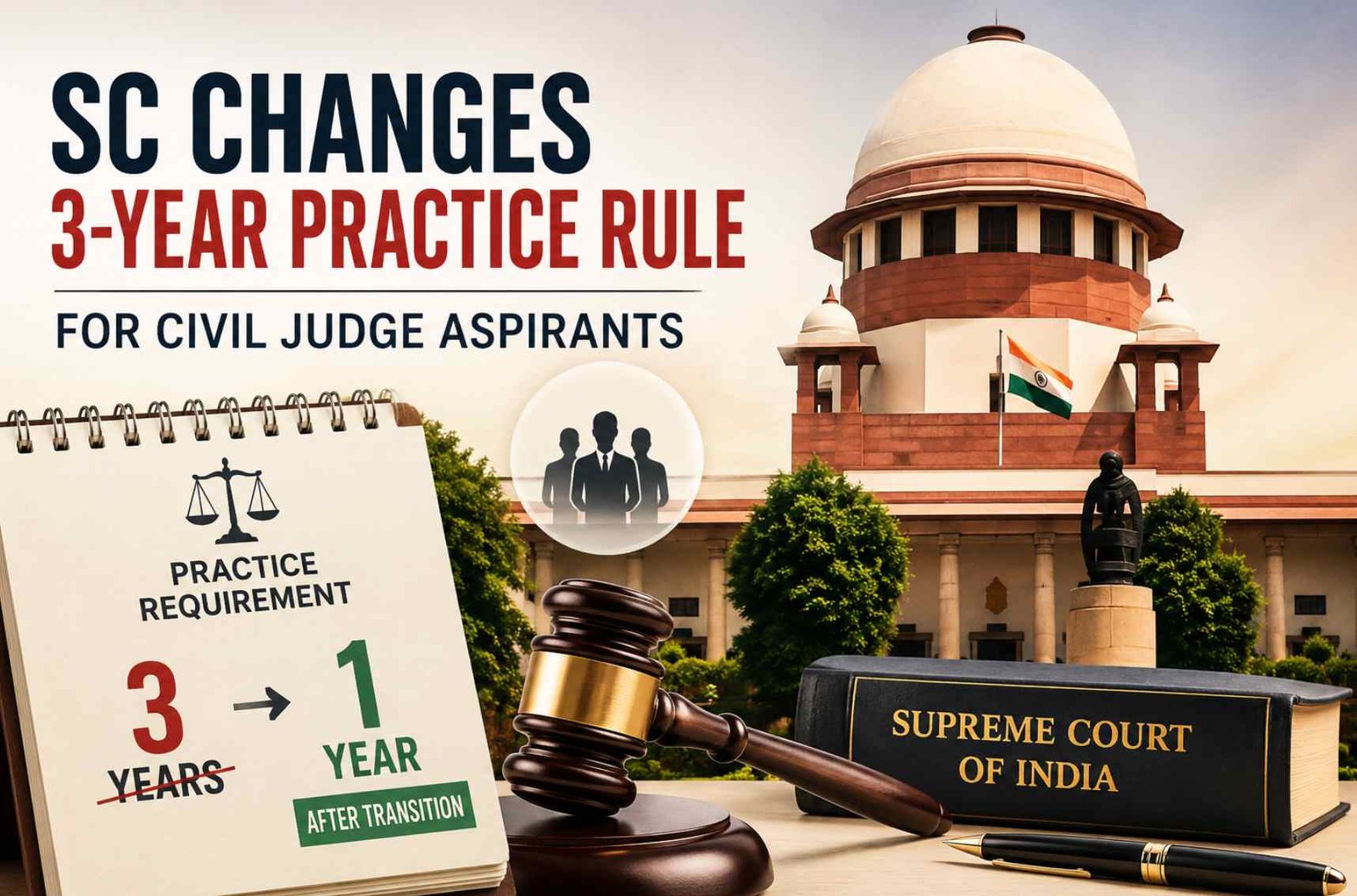
The Supreme Court has modified the three-year practice rule for Civil Judge recruitment. After the transition period, candidates will need one year of active practice. The Court also introduced structured judicial training, clerkship and transitional protection for existing judicial aspirants.
The Supreme Court on Friday, August 21, 2026, modified the manner in which practical legal experience will be required for candidates seeking direct appointment as Civil Judge (Junior Division).
Chief Justice of India Surya Kant, while pronouncing the judgment, held that the earlier decision restoring the three-year practice requirement did not warrant reconsideration on the desirability of practical experience.
However, the Court found that limited intervention was necessary regarding the manner in which the requirement was to be implemented.
The Bench observed that the sudden restoration of the three-year practice rule, without a transitional arrangement, had caused hardship to young lawyers and law graduates.
One Year Active Practice After Transition Period
The Supreme Court has now directed that, after completion of the transition period, candidates seeking appointment as Civil Judge (Junior Division) shall possess at least one year of active legal practice.
Such practice will remain subject to verification through the prescribed Certificate of Practice.
The Court has further directed that all recruitment notifications issued hereafter must conform to these directions.
The concerned High Courts have been directed to amend the relevant rules governing their judicial service cadres in accordance with the Supreme Court’s directions within three months.
Special Transitional Arrangement for Existing Aspirants
The Supreme Court has also protected candidates who were covered by judicial recruitment notifications issued during the period between May 25, 2025 and March 31, 2027.
Candidates who applied pursuant to such notifications will remain eligible irrespective of their prior practice experience.
However, their appointment will initially be made as Trainee Judicial Officers for a period of one year.
This transitional arrangement seeks to prevent candidates who entered the recruitment process under the earlier eligibility framework from being adversely affected by the subsequent modification.
Two-Year Training and Clerkship Framework
The Court has prescribed a structured practical training mechanism for trainee judicial officers.
After completing one year of training at the State Judicial Academy, the trainee judicial officer will undergo a further one year of law clerkship.
The law clerkship will itself comprise two stages:
- First six months: Under the supervision of a Principal District Judge.
- Remaining six months: Under sitting Judges of the High Court.
The arrangement effectively seeks to expose future judicial officers to both trial-level judicial functioning and the working of the High Court before they enter the regular judicial cadre.
Emoluments During Training
The Supreme Court has also addressed the financial aspect of the training period.
During the period of training at the State Judicial Academy, trainees will receive emoluments equivalent to half of the gross remuneration payable to a Judicial Magistrate First Class.
During the subsequent law clerkship, they will receive the emoluments payable during their training at the State Judicial Academy.
The Court has therefore sought to create a structured pathway combining formal judicial education with supervised practical exposure.
Practical Experience Remains Important
The Supreme Court has not rejected the rationale behind requiring practical legal experience.
The judgment under review, according to the CJI’s observations, does not require reconsideration on the question of whether practical experience is desirable for prospective judicial officers.
Instead, the Court has intervened in the mode of implementation.
The Court has held that the underlying objective can be achieved not merely through conventional practice at the Bar but also through a combination of pre-institutional training at the State Judicial Academy and supervised probation.
Such structured training and supervised experience will be treated as equivalent to practice at the Bar for the purpose of eligibility.
Relief for Young Lawyers and Law Graduates
The transitional arrangement assumes particular importance for young law graduates and lawyers who were affected by the abrupt restoration of the three-year practice condition.
The Supreme Court specifically noted that restoring the requirement without a transition period had resulted in hardship.
By protecting candidates covered by recruitment notifications issued between May 25, 2025 and March 31, 2027, the Court has attempted to balance the need for practical experience with the legitimate expectations of candidates who had already entered the recruitment process.
High Courts Given Three Months to Amend Rules
The Supreme Court has directed all concerned High Courts to modify their respective judicial service rules in conformity with the judgment.
The amendments are required to be made within three months.
Future recruitment notifications for Civil Judge (Junior Division) posts must thereafter be issued consistently with the Supreme Court’s directions.
This means that the precise eligibility framework in individual States will have to be brought into line with the constitutional court’s newly prescribed mechanism.
Persons with Disabilities
The Supreme Court has also addressed concerns relating to reasonable accommodation for persons with disabilities.
The CJI observed that the directions issued by the Court adequately address the issues raised concerning the need for accommodation for persons with disabilities.
Thus, the new framework is intended to operate alongside the requirement of appropriate accommodation for eligible candidates with disabilities.
What Has Changed?
The Supreme Court’s directions substantially alter the practical impact of the earlier three-year rule.
| Earlier Position | Position After Today’s Judgment |
| Three years’ practice requirement restored | One year active practice after transition period |
| Conventional Bar practice was central to eligibility | Structured training and supervised experience can also satisfy the objective |
| No comprehensive transitional arrangement | Candidates covered by specified notifications protected |
| Abrupt application created hardship | Transitional trainee judicial officer mechanism introduced |
| Practice requirement operated before appointment | Training, probation and clerkship form part of the new framework |
Supreme Court’s New Judicial Training Model
The judgment effectively creates a two-year structured practical pathway for the relevant trainee judicial officers:
Year 1: State Judicial Academy training
Year 2: Law clerkship
• Six months with a Principal District Judge
• Six months with sitting High Court Judges
This model reflects the Court’s view that the objective of practical exposure can be achieved through institutional training and supervised judicial experience rather than insisting exclusively upon conventional advocacy practice.
Key Directions at a Glance
The Supreme Court has directed that:
- After the transition period, Civil Judge (Junior Division) aspirants must have at least one year of active practice.
- The practice requirement will be subject to verification of a Certificate of Practice.
- Recruitment notifications issued hereafter must conform to the judgment.
- High Courts must amend their judicial service rules within three months.
- Candidates covered by judicial examination notifications issued from May 25, 2025 to March 31, 2027 remain eligible irrespective of prior practice.
- Such candidates will initially be appointed as Trainee Judicial Officers for one year.
- The structured training framework includes State Judicial Academy training followed by law clerkship.
- The law clerkship will comprise six months under a Principal District Judge and six months under sitting High Court Judges.
- The Court has addressed concerns relating to reasonable accommodation for persons with disabilities.
Follow The Legal QnA For More Updates…