














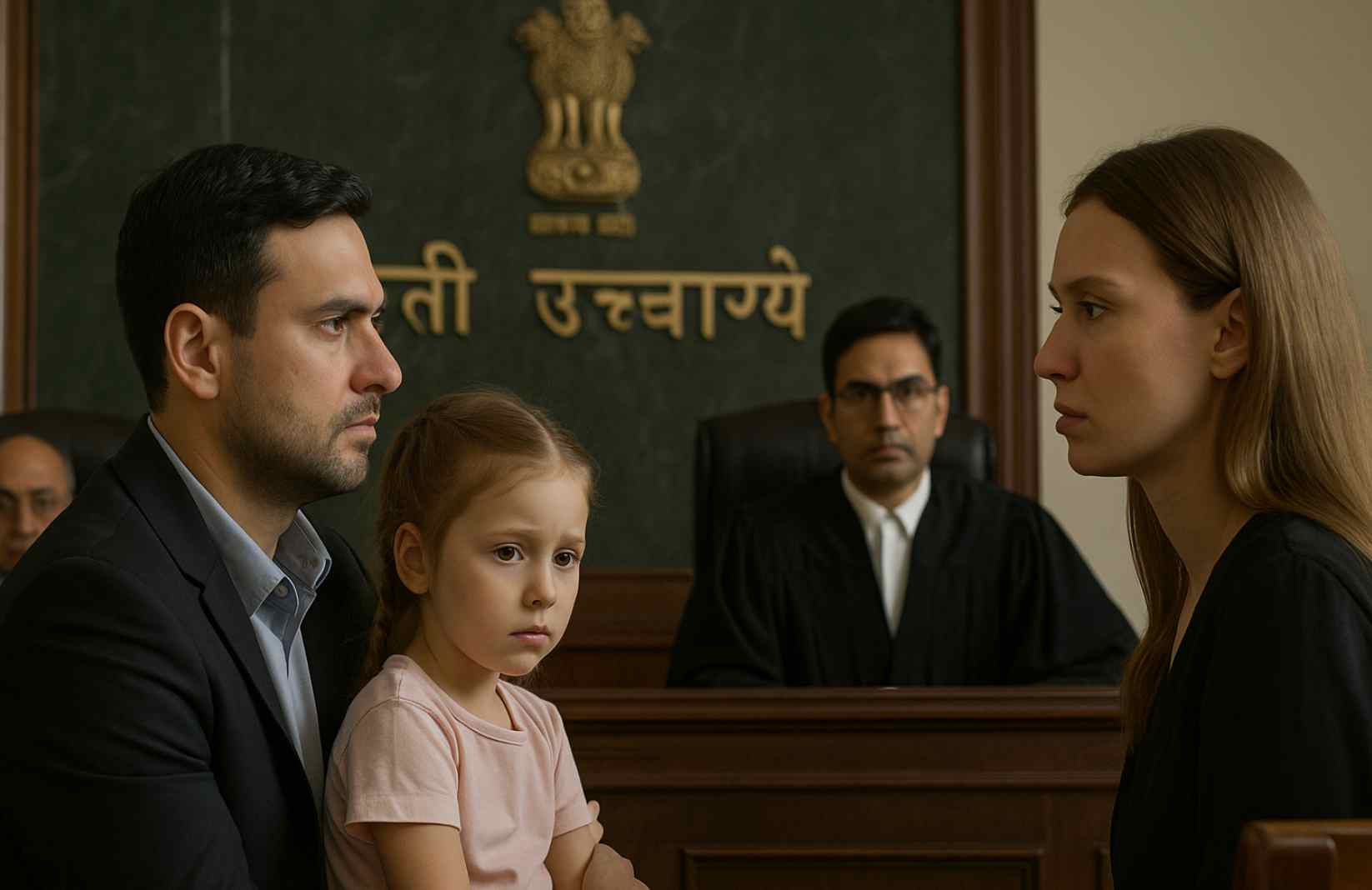
The Delhi High Court Child Custody Case involving a four-year-old girl of Indo-Russian parentage has drawn attention to cross-border custody complexities and the delicate balance between parental rights and jurisdictional integrity.
A Division Bench of Justice Anil Kshetarpal and Justice Harish Vaidyanathan Shankar upheld the Family Court’s decision to grant interim custody of the child to her Indian father, expressing serious apprehension that the Russian mother might remove the child from India, thereby rendering pending proceedings ineffective.
Court Observations and Rationale
The Bench underscored that the jurisdiction of Indian courts cannot be compromised, stressing that effective enforcement of custody orders is integral to the administration of justice. The Court noted:
“If this foundational feature were to be absent, the entire exercise would be rendered futile.”
The Court observed that both mother and daughter hold Russian passports, and the mother had earlier sought exit permits with assistance from the Russian Embassy, increasing the likelihood of flight from India.
Drawing parallels, the Bench cited a Supreme Court case where another Russian woman managed to leave India with her child despite an ongoing custody dispute.
The apex court had granted shared custody to the parents, yet the matter “stood frustrated” as the child was “snatched” away with diplomatic backing and bureaucratic lapses.
Balancing Legal Presumptions with Child’s Welfare
While acknowledging Section 6 of the Hindu Minority and Guardianship Act, 1956, which generally places a child below five years in the mother’s custody, the High Court held that the “peculiar facts and circumstances” justified deviation.
The Bench stated that the best interests of the child necessitated granting custody to the father to ensure her welfare and stability within India.
The record revealed that the couple married in 2013 and lived in Russia, where the child was born. Later, they relocated to Noida and Dehradun, but the marriage broke down amidst mutual allegations, including domestic abuse.
Current Status of Parties
According to court records, the mother, a dance and yoga instructor in Goa earning approximately ₹25,000 per month, had previously taken refuge in the Russian Embassy.
The father, on the other hand, resides at his ancestral property in Dehradun, engaged in developing it for commercial use, indicating a stable abode and financial capability.
The Bench agreed with the Family Court’s finding that the father’s environment provided greater assurance of safety, emotional security, and continuity for the child.
Legal Representation and Bench Details
- Appellant (Mother): Represented by Senior Advocate M Dutta and Advocates Aditya Guha and Anand Kumar Soni.
- Respondent (Father): Represented by Advocates Usha Mann, Deepak Gupta, and Vijayat M Bhalla.
- Bench: Justice Anil Kshetarpal and Justice Harish Vaidyanathan Shankar, Division Bench, Delhi High Court.
Follow The Legal QnA For More Updates…