










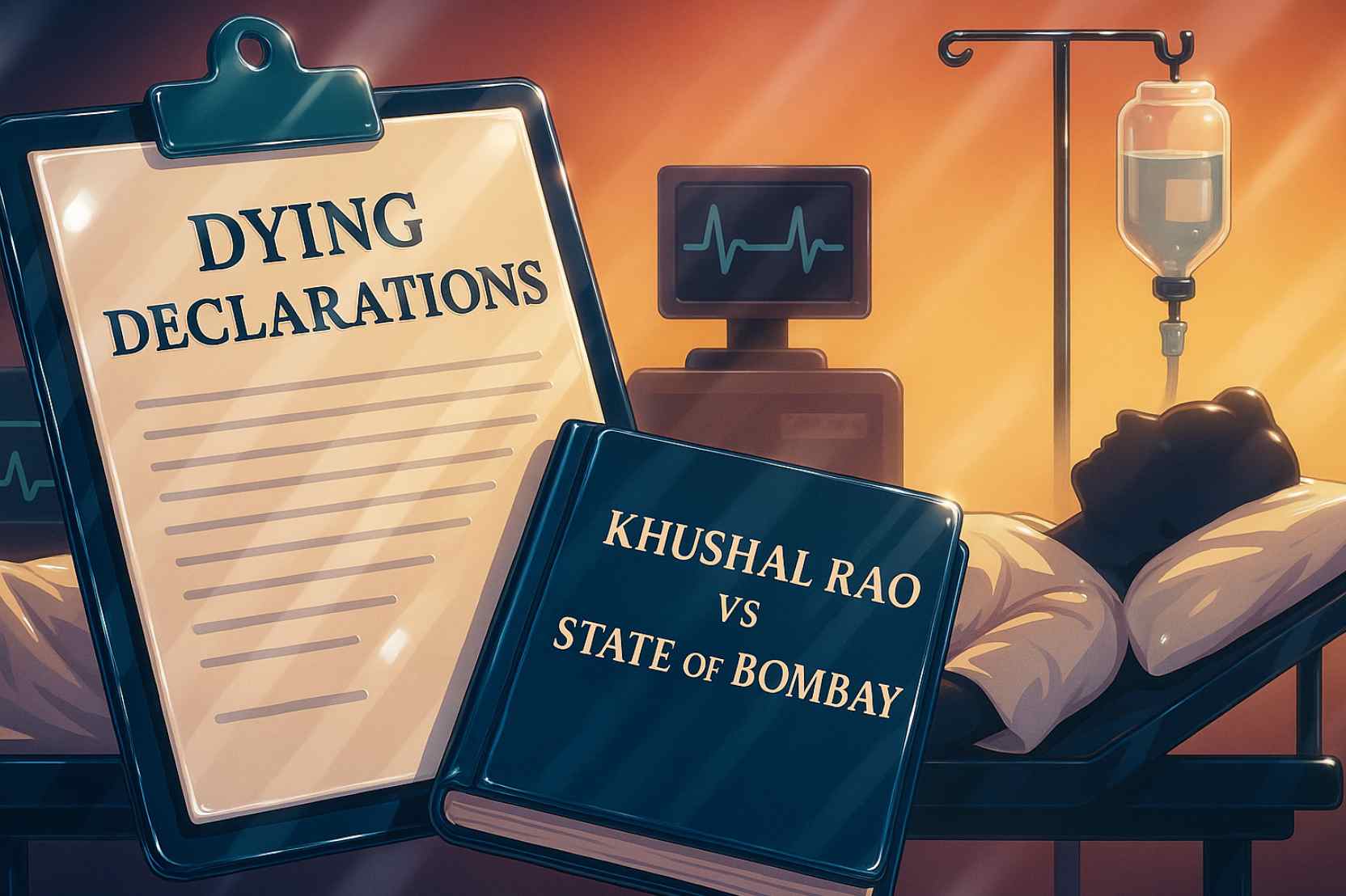
- The Supreme Court held that dying declarations must be examined carefully, as the victim may be mentally or physically unstable when giving the statement.
- In Ram Nath Madhoprasad, the Court found the declarations unreliable due to inconsistent circumstances and therefore refused to rely on them as the sole basis for conviction.
- The ruling emphasized the need for corroboration when the dying declaration appears doubtful or contradictory.
- This decision was later clarified in Kushal Rao v. State of Bombay, which stated there is no universal legal requirement to corroborate a dying declaration if it is found to be truthful and trustworthy.
The judgment in Kushal Rao versus The State of Bombay, delivered on 25 September 1957 by the Supreme Court of India, is a classical authority on the evidentiary value of dying declarations and on the scope of criminal appeals to the Supreme Court.
Speaking for the Bench, Justice Bhuvneshwar Prasad Sinha examined both the factual background and the legal principles with the care that one expects in a case involving the death penalty.
Factual Background
The case arose out of a factional rivalry in the mill area of Nagpur. On one side stood the group led by the appellant, Kushal Rao, and one Tukaram.
On the opposite side stood persons like Inayatullah, Ramgopal and Tantu.
Prior incidents of violence had already taken place between these rival groups, and criminal cases were pending on both sides.
On the night of 12 February 1956, at about nine in the evening, Baboolal was assaulted in a narrow lane in Nagpur.
According to the prosecution, he was attacked with swords and spears by four persons, prominently including the appellant. He received multiple punctured and incised wounds.
Baboolal was taken immediately to Mayo Hospital. He reached there at about nine twenty five in the evening.
The attending doctor, Dr Kanikdale, questioned him as to the cause of his injuries and recorded on the bed head ticket that Baboolal had stated he had been assaulted by Kushal and Tukaram with swords and spears.
The doctor then informed the police station by telephone. Upon receiving this information, the Sub Inspector, A K Khan, registered an offence initially under section 307 of the Indian Penal Code and proceeded to the hospital.
Related Articles

Finding Baboolal in a serious condition and fearing that he might not survive until a magistrate arrived, the Sub Inspector decided to record his statement himself. He did so around ten fifteen in the evening.
In the meantime, a First Class Magistrate, Shri Khetkar, was summoned. He recorded another statement from Baboolal between 11:15 and 11:35 in the presence of a doctor, who certified that the injured man was in a fit mental state to give a statement.
Thus, within a span of roughly two hours, three dying declarations came into existence.
The first was recorded by the doctor in the hospital records, the second by the Sub Inspector as part of the first information of the occurrence, and the third by the magistrate in the formal manner of a dying declaration with medical certification of fitness.
In all of them, Baboolal named Kushal and Tukaram as his assailants and described the manner of the attack.
Baboolal succumbed to his injuries the following morning at about ten.
Investigation and Trial
After these statements, the police began to search for the accused. The appellant was not found at his residence.
Four days later, he was arrested in an outhouse locked from the outside, in a bungalow at Seminary Hill, Nagpur.
The prosecution asserted that this showed he was absconding and concealing himself to avoid arrest. Tukaram was arrested subsequently.
In due course, four persons, including the appellant and Tukaram, were put on trial for the murder of Baboolal under section 302 of the Indian Penal Code.
What does Section 302 of the Indian Penal Code state?
Section 302: Punishment for Murder
Section 302 of the IPC prescribes the punishment for the offence of murder, as defined under Section 300 IPC. It provides that a person found guilty of murder will face either: death or imprisonment for life, along with a monetary fine at the discretion of the court. The section reflects the seriousness with which Indian criminal law views the unlawful and intentional taking of life.
The Sessions Judge convicted the appellant under section 302 and sentenced him to death, holding that he was the principal offender and that there were no extenuating circumstances.
Tukaram was also convicted, but his sentence was limited to imprisonment for life on the view that he had acted under the instigation of the appellant.
The other two accused were acquitted, as they had not been named in the dying declarations, and the oral evidence was not of sufficient reliability to implicate them.
As required by law, the death sentence on the appellant was submitted to the High Court for confirmation.
Along with this reference, there were appeals by the convicted accused, an appeal by the State against acquittal of the other two accused, and a revision for enhancement of Tukaram’s sentence.
The Nagpur High Court, in a careful and detailed judgment, examined the matter. It made a local inspection of the scene of occurrence to better appreciate the oral evidence.
The High Court was not prepared to place reliance on the partisan testimony of the alleged eye witnesses, Inayatullah and Sadashiv, and held that their evidence could not serve even as corroboration. It came to similar conclusions regarding certain other witnesses.
However, the High Court accepted the three recorded dying declarations as authentic and truthful. It held that they were corroborated, so far as the appellant was concerned, by his subsequent conduct in absconding and being found concealed in an outhouse.
On this basis, the High Court confirmed the conviction and death sentence of Kushal, while acquitting Tukaram by giving him the benefit of doubt, mainly due to confusion regarding the description of his caste and the existence of other persons named Tukaram in the locality.
The State’s appeal against the acquittal of the other two accused and for enhancement of Tukaram’s sentence was dismissed.
Related Articles
Certificate for Appeal to the Supreme Court
The appellant then sought a certificate of fitness for appeal under Article 134 clause 1, sub clause c of the Constitution. The High Court granted such a certificate.
What does Article 134(1)(c) of the Constitution of India state?
Article 134(1)(c): Appeal By Special Leave
Article 134(1)(c) empowers a High Court to grant a certificate of fitness for appeal to the Supreme Court in criminal matters. This clause applies when the High Court believes that a case involves a substantial question of law or an issue of that requires consideration by the Supreme Court. It is not meant for ordinary questions of fact or reappreciation of evidence, but for matters that carry wider implications for justice or legal principles.
The principal reason it was recorded was that there might have been an error in treating the appellant’s absconding as corroboration, particularly because there were some defence documents suggesting that he may have been avoiding arrest in a separate excise case, and not solely due to the murder charge.
Thus, the High Court felt that the sufficiency of the evidence, particularly in light of this aspect, required consideration by the Supreme Court.
Supreme Court on the Scope of Article 134(1)(c)
At the very outset, Justice Sinha addressed the propriety of the certificate granted by the High Court.
The Supreme Court reiterated a principle of considerable importance for criminal practice.
The Court emphasized that it does not function ordinarily as a general court of criminal appeal on facts.
Appeals on questions of fact are envisaged under Article 134, clause 1, subclauses a and b, which deal with cases where the High Court has reversed an acquittal or withdrawn a case and convicted an accused.
Under Article 134 clause 1 sub clause c, however, a certificate can only be granted when there is some substantial question of law or principle involved, not merely when the High Court is doubtful about its own factual appreciation or sufficiency of evidence.
To grant a certificate on the grounds of fact is, as the Court observed, beyond the competence of the High Court.
In the present case, the High Court had virtually confessed that the main ground for the certificate was its doubt about the sufficiency of evidence, particularly the use of absconding as corroboration.
This, according to the Supreme Court, was not a proper basis for a certificate under the said provision. On that reasoning, the certificate was held incompetent.
However, in fairness to the appellant, the Supreme Court did not reject the matter on that technical ground alone.
Instead, it examined the record to consider whether the case disclosed any grounds on which special leave could have been granted under Article 136.
It found none and proceeded to deal with the principal legal question that had arisen, namely, the value of dying declarations.
Must a Dying Declaration be Corroborated?
The appellant relied strongly on a previous decision of the Supreme Court in Ram Nath Madhoprasad versus The State of Madhya Pradesh, where certain observations were made to the effect that it is not safe to base a conviction solely on a dying declaration without corroboration.
Ram Nath Madhoprasad v. State of Madhya Pradesh (1953)
In this early Supreme Court decision, the Court examined the reliability of several dying declarations. It held that a dying declaration, if unclear or recorded under doubtful circumstances, should not be the sole basis of conviction without supporting evidence. The Court emphasized that the victim may be mentally or physically unstable at the time of narration, and therefore such statements require careful scrutiny. Although often misquoted as a general rule requiring corroboration, the judgment’s reasoning was later clarified in Kushal Rao v. State of Bombay (1957), which stated that there is no absolute legal requirement to corroborate a dying declaration if it is found to be truthful and reliable.
On the strength of those observations, it was argued that, as a matter of law, a dying declaration cannot by itself be the foundation of conviction and must be supported by independent evidence.
Justice Sinha undertook a comprehensive analysis of this contention. He noted that in Ram Nath’s case, the Court, on the facts, had held that the dying declaration there was not a truthful version of the occurrence.
The discussion about the need for corroboration was, therefore, not the ratio of that decision but was in the nature of an observation. The Court thus characterized those remarks as obiter dicta.
The Bench then turned to Section 32 (1) of the Indian Evidence Act. This provision treats a statement by a person who dies, relating to the cause of his death or the circumstances of the transaction that resulted in his death, as a relevant fact.
What does Section 32(1) of the Indian Evidence Act state?
Section 32(1): Statements of Persons Who Cannot Testify
This provision allows the admission of statements made by a person who has died, or who cannot be found, or whose presence cannot be obtained without unreasonable delay or expense. It specifically covers statements that relate to the cause of their death or to the circumstances of the transaction leading to their death.
In simpler terms, when a victim explains how they were injured or who attacked them, and later dies, their statement is legally admissible as evidence. This is commonly known as a dying declaration.
The section is an express exception to the general rule that hearsay is inadmissible and that evidence must ordinarily be tested by cross-examination.
The Court explained the rationale.
A dying person is presumed to speak the truth because he is standing at the edge of death, with no motive to lie, and the sanctity of that situation is treated by the law as a substitute for the oath and cross-examination that are otherwise required.
Therefore, the statute itself accords special weight to such statements. Their admissibility is unquestioned. The only issue is the weight to be attached to them, which depends on the circumstances of the particular case.
Justice Sinha then surveyed the conflicting approaches taken by different High Courts in India and by courts in other jurisdictions on this issue.
Some courts had insisted on corroboration as a matter of prudence, while others had upheld convictions solely on reliable dying declarations.
He referred approvingly to the Full Bench decision of the Madras High Court in In re Guruswami Tevar, which held that it is not possible to lay down any rigid rule requiring corroboration and that if the Court is fully satisfied that the dying declaration is true, it is its duty to convict even in the absence of corroboration.
After reviewing the case law and the text of the Evidence Act, the Supreme Court laid down clear propositions:
- First, there is no rule of law and not even a uniform rule of prudence that a dying declaration must be corroborated before it can form the basis of conviction.
- Second, each case must be judged on its own facts, with the court closely scrutinizing the circumstances in which the statement was made, the mental and physical condition of the maker, the opportunity to observe the assailants, the consistency of statements, and the absence of tutoring or external influence.
- Third, a dying declaration recorded by a competent magistrate in question and answer form, with medical certification of mental fitness, is entitled to a particularly high degree of credit, provided it appears free from suspicious circumstances.
- Fourth, a dying declaration is not to be equated with the testimony of an accomplice or with a retracted confession. Those categories are suspect by their very nature and require corroboration as a rule of law. A dying declaration usually comes from a person with no motive to implicate falsely, unless specific circumstances suggest otherwise.
In short, the Court held that the need for corroboration arises not from any inherent weakness of dying declarations, but from defects or infirmities in the particular declaration under consideration.
If the court finds a given dying declaration wholly reliable, no further corroboration is legally required.
Application of Law to the Facts
Having clarified these principles, the Supreme Court then examined whether the dying declarations of Baboolal passed the test of reliability.
It found that:
Baboolal made his first statement to the doctor within about half an hour of the assault, leaving little scope for tutoring or fabrication.
He consistently named the appellant and Tukaram in all three recorded statements.
The nature of injuries, consisting of punctured and incised wounds, matched his account of being attacked with sharp and piercing weapons.
The courts below had found that there was sufficient light at the place of occurrence and that Baboolal was in a position to see and identify his assailants.
There was no evidence that the statements were prompted or that they were recorded in an improper manner.
On these facts, the Supreme Court held that the dying declarations bore the clear stamp of truth and reliability. There was no aspect of them that had been shown to be false or doubtful.
The Court therefore concluded that the dying declarations, taken together, were sufficient to base the conviction upon, even leaving aside the question of corroboration by absconding.
The Court then briefly addressed the conduct of the appellant in absconding.
While it did not rest its conclusion on that aspect alone, it agreed with the High Court that his being found hidden in a locked outhouse four days later was a circumstance consistent with guilt and not adequately explained by the vague reference to an excise case.
But this was treated as an additional circumstance, not as an indispensable corroboration.
Finally, the Court considered whether there were any extenuating circumstances that would justify commuting the death sentence to life imprisonment. It found none.
The assault was held to be a deliberate, premeditated act of murder arising out of factional hostility, with no sudden provocation or mitigating factor. The sentence of death was therefore confirmed.
Conclusion
From an advocate’s perspective, Kushal Rao versus The State of Bombay serves as a leading authority on two important aspects.
Firstly, it cautions High Courts against granting certificates under Article 134 clause 1 sub clause c merely because they feel uneasy about their own factual conclusions. The Supreme Court clearly marks the boundaries of that jurisdiction and reserves its factual appellate role for cases falling under the specific constitutional provisions or where special leave is warranted.
Secondly and more significantly, the judgment authoritatively settles the law that a dying declaration can, in an appropriate case, be the sole foundation for a conviction, including for the offence of murder, provided the court is fully satisfied of its truth and reliability after close scrutiny.
This case is therefore indispensable in any serious study or argument concerning Section 32 clause 1 of the Indian Evidence Act and continues to be cited as the definitive pronouncement on the subject of dying declarations in Indian criminal law.
Follow The Legal QnA For More Updates…
Article Sources
▾
The Legal QnA maintains the highest standards of accuracy and integrity in its legal content. Our writers and contributors rely on primary sources such as statutory laws, government notifications, regulatory circulars, and judicial precedents. We also incorporate insights from recognized legal commentaries, expert opinions, and academic publications where relevant. Every article is fact-checked and reviewed by qualified professionals to ensure it reflects current law and authoritative interpretation.
Refer to the official sources below for in-depth reading:
- India Kanoon: https://indiankanoon.org/doc/1428689/
- Bhubaneswar District Court PDF: https://cdnbbsr.s3waas.gov.in/s3ec015a01f0597ac4bdf35c24846734ee/uploads/2024/03/2024031223.pdf
- Manupatra Academic Evidence Notes: http://student.manupatra.com/Academic/Abk/Law-of-Evidence/Chapter4.htm
- LiveLaw Case Commentary: https://www.livelaw.in/top-stories/supreme-court-conviction-dying-declaration-without-corroboration-190878