














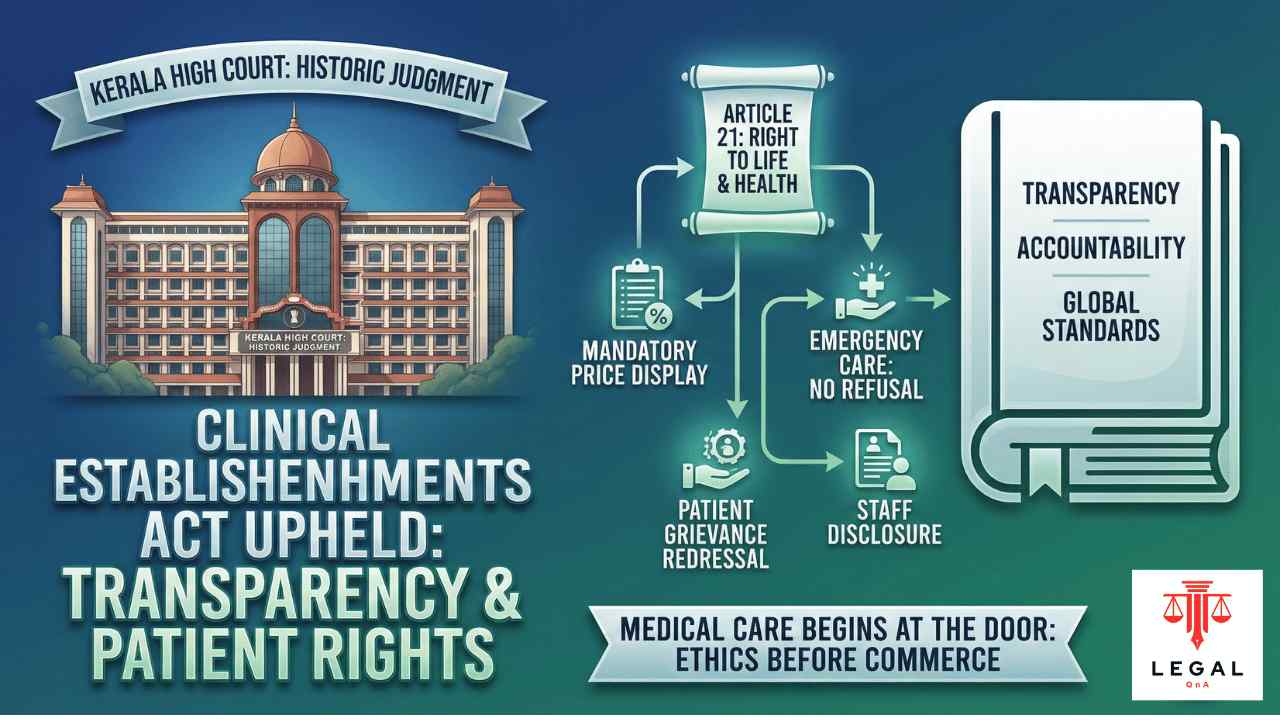
- Hospitals in Kerala must clearly display baseline and package rates at their reception areas and on their official websites.
- No clinical establishment can deny initial lifesaving treatment due to non-payment or lack of documents.
- Staff details are to be provided only for regulatory verification, not for public disclosure.
- Every hospital must operate a grievance desk, provide complaint reference numbers, and resolve issues within seven working days.
The Kerala Clinical Establishments Act has now become the new reference point for medical standards and patients’ rights in the State.
In a detailed and precedent-setting pronouncement, the Kerala High Court upheld the entire legislative framework and dismissed the challenges raised by the Indian Medical Association and the Kerala Private Hospitals Association.
The Division Bench comprising Justice Sushrut Arvind Dharmadhikari and Justice Syam Kumar V.M. wrote a judgment that blends constitutional duties, public health priorities and global standards of medical ethics.
The verdict reframes the relationship between private healthcare providers and patients. Hospitals are no longer permitted to treat admission as a commercial gate.
Medical care begins at the door. Stabilisation according to capacity must be given and lifesaving procedures cannot be denied for want of advance payment or incomplete paperwork.
The Court’s language is direct. It affirms that medical establishments exist to treat illness first and collect charges later under lawful billing practices.
Related Articles


Constitutional Foundations and Global Parity
The Court rejected allegations that the legislation is arbitrary or impractical. The Division Bench observed that the Kerala Clinical Establishments Act simply puts into practice constitutional duties that already exist.
Article 21 does not remain a philosophical commitment without implementation. The Act translates it into a standards-based registration system, a transparency mandate and enforceable minimum requirements.
What is Article 21?
“No person shall be deprived of his life or personal liberty except according to procedure established by law.”
Article 21 guarantees the Protection of Life and Personal Liberty. It is the most progressive article in the Indian Constitution. Through judicial activism, it has evolved from a restriction on state power to a positive right ensuring a meaningful life, including the right to privacy and livelihood.
The Bench compared the Kerala framework with advanced healthcare regulations in the United States and the European Union.
Core rights such as informed consent, emergency stabilisation, transparent pricing and non-discrimination are foundational principles of modern medical jurisprudence.
Kerala’s regime, therefore, stands aligned with global norms rather than as an isolated administrative imposition.
Mandatory Display of Prices: Clear, Public, and Accessible
Under the Kerala Clinical Establishments Act, every hospital must show baseline tariffs for commonly performed procedures and services at admission counters, billing areas and on official websites.
The Court clarified that medical providers are not expected to predict every clinical complication beforehand. What is expected is a good-faith baseline for identifiable procedures such as surgeries, diagnostics or standard packages.
Complications, co-morbidities and extended ICU care may be billed separately but must be itemised with clinical justification. This prevents exploitative charging and ensures that a patient understands what they are paying for.
The Bench specifically noted that transparency mandates are less intrusive than fixed price controls. They preserve hospital autonomy while protecting public interest.
Professional Staff Disclosure: Regulatory Purpose, Not Publicity
One of the central grievances of the petitioners concerned the requirement to disclose details of hospital staff. The Court rejected the argument that this violates privacy.
The information is not meant for public consumption but only for the registering authority to verify qualifications, adequacy of staffing and competence.
Invoking the principles of proportionality in the Puttaswamy privacy judgment, the Court explained that the directive has legality, pursues a legitimate aim, is reasonably proportionate and carries procedural safeguards.
K.S. Puttaswamy v. Union of India (2017)
In this historic 9-judge bench ruling, the Supreme Court unanimously declared the Right to Privacy as a Fundamental Right under Article 21. The judgment overruled previous precedents, establishing that privacy is intrinsic to human dignity and liberty, protecting citizens’ autonomy over their body, mind, and data from state intrusion.
The authority must issue guidelines on data minimisation, confidentiality, access control and retention. No clinical establishment is required to publicly reveal the personal data of its doctors or nurses.
Related Articles


Emergency care and safe medical transfer: no refusal for non payment: Stabilise first, bill later
Every clinical establishment in Kerala must treat emergency patients within their capacity. The Bench issued a categorical direction that denial of aid on the ground of non payment or documentation lapses is unacceptable.
This includes:
- initial stabilisation,
- lifesaving intervention and
- safe transfer to a higher centre if required.
Safe transfer is not merely an ambulance journey. Hospitals must communicate with the receiving facility, provide essential documentation and ensure continuity of care.
The Court emphasised that life is not a negotiable commodity. In trauma, cardiac shock, obstetric emergency or acute crises, hospitals cannot seek advances as prerequisites.
Upon discharge, hospitals must provide the discharge summary and every diagnostic report including ECG, X Ray, CT scan or other relevant findings. Patients have the right to keep their medical records without delay or selective withholding.
Mandatory patient information at the time of admission
Each hospital must supply an updated brochure at admission and also make it downloadable from its website.
The document must clearly list services,
- baseline and package rates,
- deposits,
- refund rules,
- insurance procedures,
- billing policy,
- ambulance charges,
- emergency protocols
- and grievance escalation paths.
This step converts opaque practices into accessible knowledge. Patients and families are not expected to decode complicated pricing or process information after a crisis. The Court insisted on clarity at the very first touchpoint.
Grievance redressal: formal structure not polite assurances
The Kerala Clinical Establishments Act requires each establishment to maintain a grievance desk or helpline. Complaints must be immediately acknowledged with a reference number through SMS, WhatsApp, or a physical receipt.
All grievances must be resolved within seven working days. If the issue is serious or remains unresolved, it must be escalated to the District Registering Authority without delay.
A physical or electronic complaint register must be maintained for inspection. Monthly summaries of complaints and actions taken must be submitted to the competent authority. Hospitals cannot bury grievances inside administrative piles.
Undertakings and verification
Within thirty days of the judgment, every clinical establishment must file an undertaking of compliance with Sections 39 and 47. Within sixty days, the District Authority must conduct verification audits and thereafter perform periodic reviews.
What do Sections 39 and 47 of the Kerala Clinical Establishments Act state?
Section 39: Transparency & Billing
Every clinical establishment must prominently display its Registration Certificate and a detailed list of charges and package rates in both Malayalam and English. Importantly, hospitals are legally barred from charging more than the rates they have displayed.
Section 47: Emergency Care
This section mandates that hospitals provide immediate medical examination and treatment to save a patient’s life within their capacity. It also requires them to ensure the safe transport of the patient to a higher facility if needed, without waiting for payment.
Deficiencies trigger action in accordance with the Act and Rules including penalties, suspension or cancellation of registration.
The Court has also directed the government to widely publicise these directions in Malayalam and English for one month through mainstream media so citizens are aware of their rights. Awareness is a necessary limb of enforcement.
Related Articles


Remedies remain multi-channel
Patients are free to proceed before the Consumer Commissions for deficiency of service. Complaints involving cheating or fraudulent conduct may be filed before police.
Systemic grievances may be escalated to the Chief Secretary or the State Police Chief. Legal Services Authorities may be approached for legal guidance and support. Hospitals must cooperate fully and provide receipts for payments and complaints.
Kerala Clinical Establishments Act: The Court’s final view
The Division Bench concluded that the Kerala Clinical Establishments Act does not impose unnecessary burdens on hospitals. It operationalises constitutional values.
What is Kerala Clinical Establishments Act, 2018?
This Act mandates the compulsory registration of all public and private medical establishments in the state to ensure quality healthcare. It enforces transparency in treatment rates, requires the display of facility details, and establishes minimum standards for infrastructure and staffing to protect patient rights.
It enforces transparency. It secures emergency care and safeguards patients against information asymmetry. Healthcare, in the eyes of the law, must remain ethical, dignified, and equitable.
Bench Details
- Division Bench
- Justice Sushrut Arvind Dharmadhikari
- Justice Syam Kumar V.M.
Party Names
- Kerala Private Hospitals Association and another versus State of Kerala and others
- Connected matter involving the Indian Medical Association
Case Details
- Case No WA No 1621 of 2025 and connected case
Follow The Legal QnA For More Updates…
Kerala Private Hospitals Association and Anr. v. State of Kerala and Ors.