






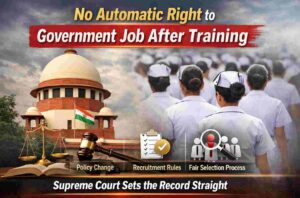








The Supreme Court has set aside the Kerala High Court’s directions requiring the Airport Authority of India to appoint an unreserved-category candidate to the post of Junior Assistant (Fire Service), holding that reserved-category candidates who secure selection on their own merit must be treated as occupying unreserved posts and that the High Court erred in interfering with the completed recruitment process.
Background of the Recruitment Dispute
The dispute arose from a recruitment process initiated by the Airport Authority of India (AAI) in 2013 through Advertisement No. 01/SR/2013 for the post of Junior Assistant (Fire Service).
A total of 245 posts were notified, comprising 122 unreserved vacancies, 78 for Other Backward Classes (OBC), 22 for Scheduled Castes (SC), and 23 for Scheduled Tribes (ST), including a carried-forward vacancy.
The selection process was extensive. Out of 12,891 applicants, 7,278 candidates were found eligible to appear in the written examination.
Following qualifying marks and subsequent physical tests, driving tests, endurance tests, and interviews, 185 candidates remained eligible at the final stage. Of these, 158 candidates were selected, while 27 were placed on a panel.
Sham Krishna B., the writ petitioner and first respondent before the Supreme Court, participated in all stages of the selection and qualified throughout but did not find his name in the final list of selected candidates. He secured an aggregate score of 128.08 marks out of 225 and stood at merit position 132.
RTI Disclosures and Challenge Before the High Court
As the select list was not uploaded on the official website, the respondent sought information under the Right to Information Act, 2005. The disclosures revealed that while all 122 unreserved posts were filled, only 10 OBC posts and 4 ST posts were filled, leaving a substantial number of reserved vacancies unfilled. This disclosure formed the basis of the respondent’s grievance.
Contending that the reservation policy and roster were improperly applied and that reserved-category candidates were wrongly accommodated against unreserved posts, the respondent approached the Kerala High Court in Writ Petition No. 35998 of 2016.
Findings of the Single Judge and Division Bench
The learned Single Judge allowed the writ petition, holding that appointments were vitiated because only 158 out of 245 notified vacancies had been filled and the reservation roster had not been correctly applied.
Directions were issued to publish the rank list and re-arrange candidates strictly in accordance with the model roster under the Department of Personnel and Training (DoPT) Office Memorandum dated July 2, 1997.
On appeal, the Division Bench of the Kerala High Court substantially affirmed the findings but modified the relief.
While declining to disturb appointments already made, it directed that Sham Krishna B. be appointed against a vacancy kept unfilled and ordered the AAI to publish rank lists and ensure future adherence to the roster.
Issues Before the Supreme Court
The Supreme Court was called upon to examine whether reserved-category candidates who secured higher marks without availing any relaxation could be counted against unreserved vacancies and whether the High Court was justified in directing appointment of the writ petitioner after completion of the recruitment process.
The Airport Authority of India argued that the High Court misunderstood the concept of merit-based selection and the role of the reservation roster, contending that a reserved-category candidate who qualifies on merit must be treated as a general candidate.
Supreme Court’s Analysis on Reservation and Merit
The Court undertook a detailed analysis of the DoPT Office Memorandum of July 2, 1997, and reiterated the settled principle that a reservation roster is not a tool for conducting selection but an administrative instrument used post-selection to monitor cadre strength and determine future vacancies.
The Bench observed that the High Court failed to appreciate that the roster comes into play only after the selection process concludes and employees join service. It emphasized that the roster cannot displace candidates who legitimately secure unreserved posts on merit.
Rejecting the contention that unreserved posts could only be filled by candidates belonging to the unreserved category, the Court reaffirmed that merit-based inclusion of reserved-category candidates in the unreserved list does not amount to a violation of reservation norms.
Reliance on Established Precedent
The judgment relied heavily on established constitutional principles governing affirmative action and equality in public employment.
The Court reiterated that the “open” or “unreserved” category is open to all candidates irrespective of caste or category, provided selection is purely on merit without availing reservation benefits.
The Bench observed that migration or adjustment of reserved-category candidates into unreserved posts based on merit is not only permissible but constitutionally mandated to uphold equality under Articles 14 and 16 of the Constitution.
Errors in the High Court’s Approach
The Supreme Court found that the Kerala High Court erred in assuming that unreserved vacancies must be filled exclusively by unreserved-category candidates. Such an approach, the Court held, would undermine merit and distort the very purpose of open competition.
It was also noted that all 122 unreserved vacancies were duly filled based on merit and that the respondent did not score higher than the last selected unreserved candidate.
Consequently, his placement in the waiting panel did not confer any enforceable right to appointment.
Final Ruling and Directions
Allowing the appeal filed by the Airport Authority of India, the Supreme Court set aside the judgments of both the Single Judge and the Division Bench of the Kerala High Court.
It categorically held that no direction for appointment of the respondent or any other unreserved-category candidate could be sustained once all unreserved vacancies had been filled strictly on merit.
The appeal filed by the impleaded candidate was dismissed, and no order as to costs was passed.
Case Details
- Case Title: Airport Authority of India & Ors. v. Sham Krishna B & Ors.
- Court: Supreme Court of India
- Bench: Justice M.M. Sundresh and Justice Satish Chandra Sharma
- Date of Judgment: January 16, 2026
- Citation: 2026 INSC 69
- Arising Out of: SLP (C) No. 10686 of 2020 and SLP (C) No. 12937 of 2021
Follow The Legal QnA For More Updates…